Challenge Setup
Tools Used:
- hashid — Identifying hash types
- Hashcat — Dictionary and mask attacks against hashes
- John the Ripper — Wordlist-based hash cracking
- CrackStation — Online hash lookup for common hashes
Environment:
- Kali Linux (attacker machine)
- TryHackMe platform
Challenge Overview
There was no target machine to scan — the room consisted entirely of hash-cracking tasks. Section 1 covered a mix of common hash types with no hints about the wordlist. Section 2 explicitly stated that all hashes were crackable with rockyou.txt, and included salted hashes requiring specific Hashcat modes.
Solution
Section 1
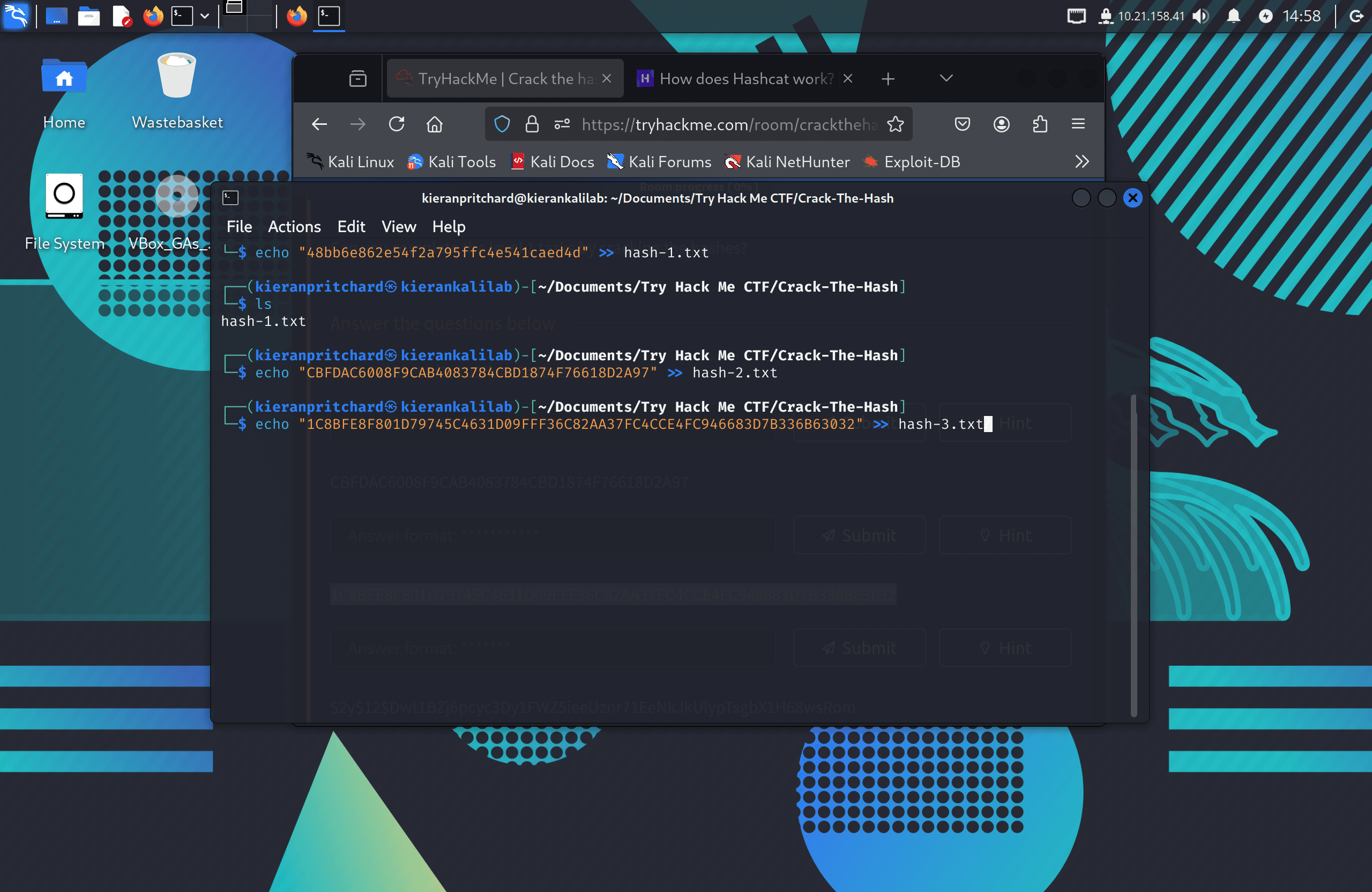
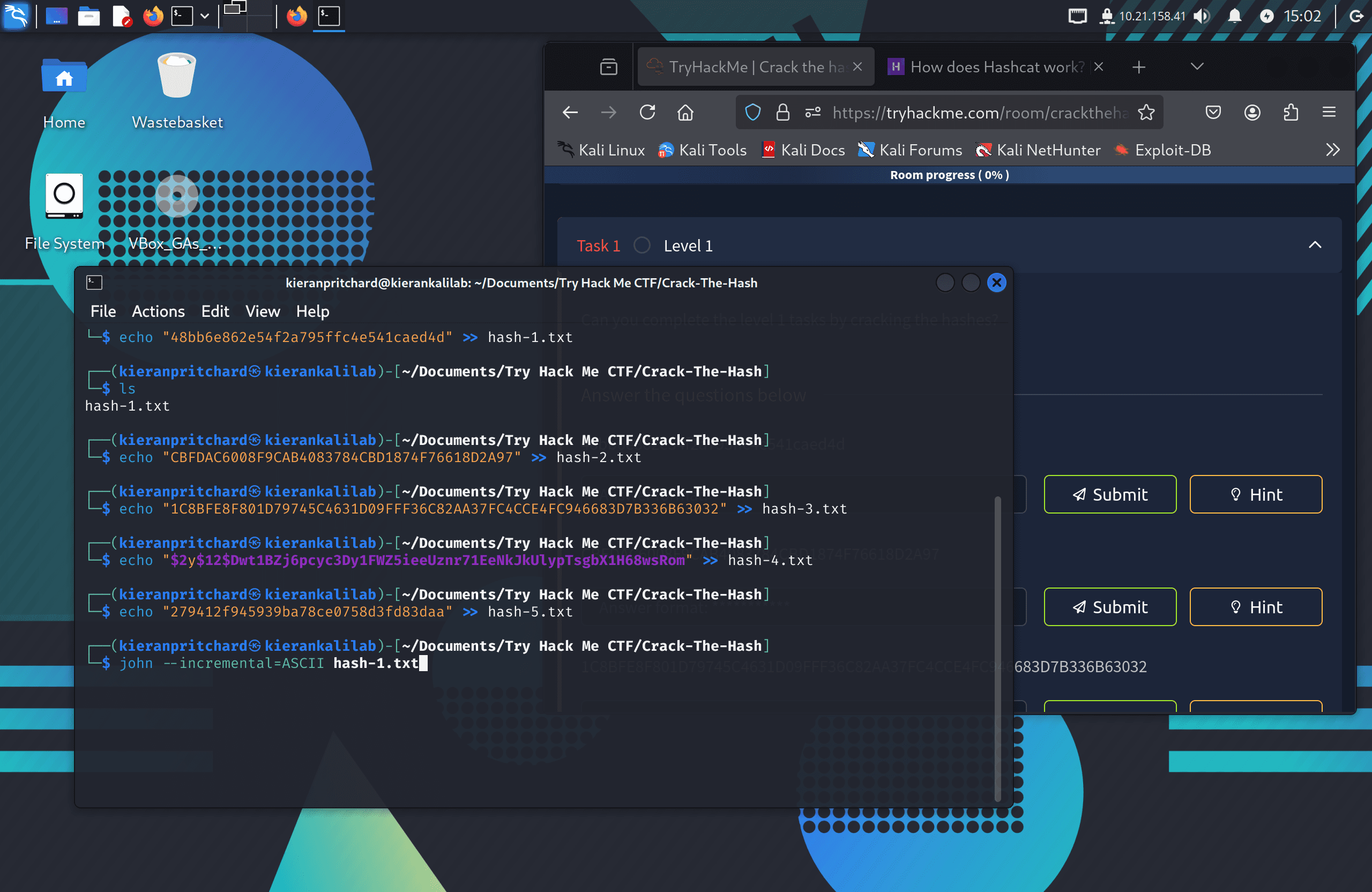
Each hash was saved to an individual text file for use with Hashcat or John the Ripper. hashid was used to identify hash types before attempting to crack.
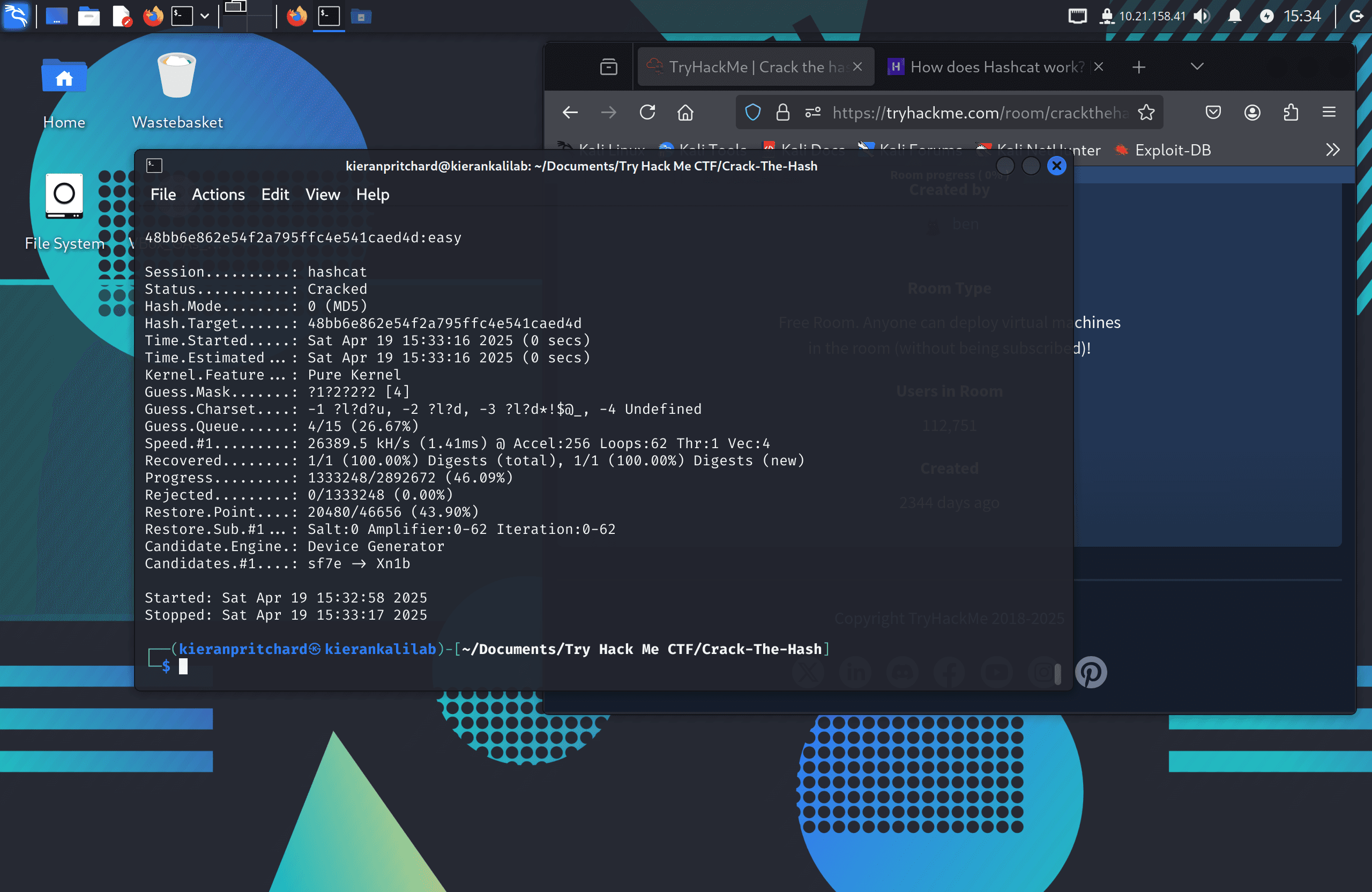
Hash 1: 48bb6e862e54f2a795ffc4e541caed4d
Identified as MD5. Cracked with Hashcat:
hashcat -m 0 hash.txt /usr/share/wordlists/rockyou.txt
Password: easy
Hash 2: CBFDAC6008F9CAB4083784CBD1874F76618D2A97
Identified as SHA-1. Cracked using CrackStation.
Password: password123
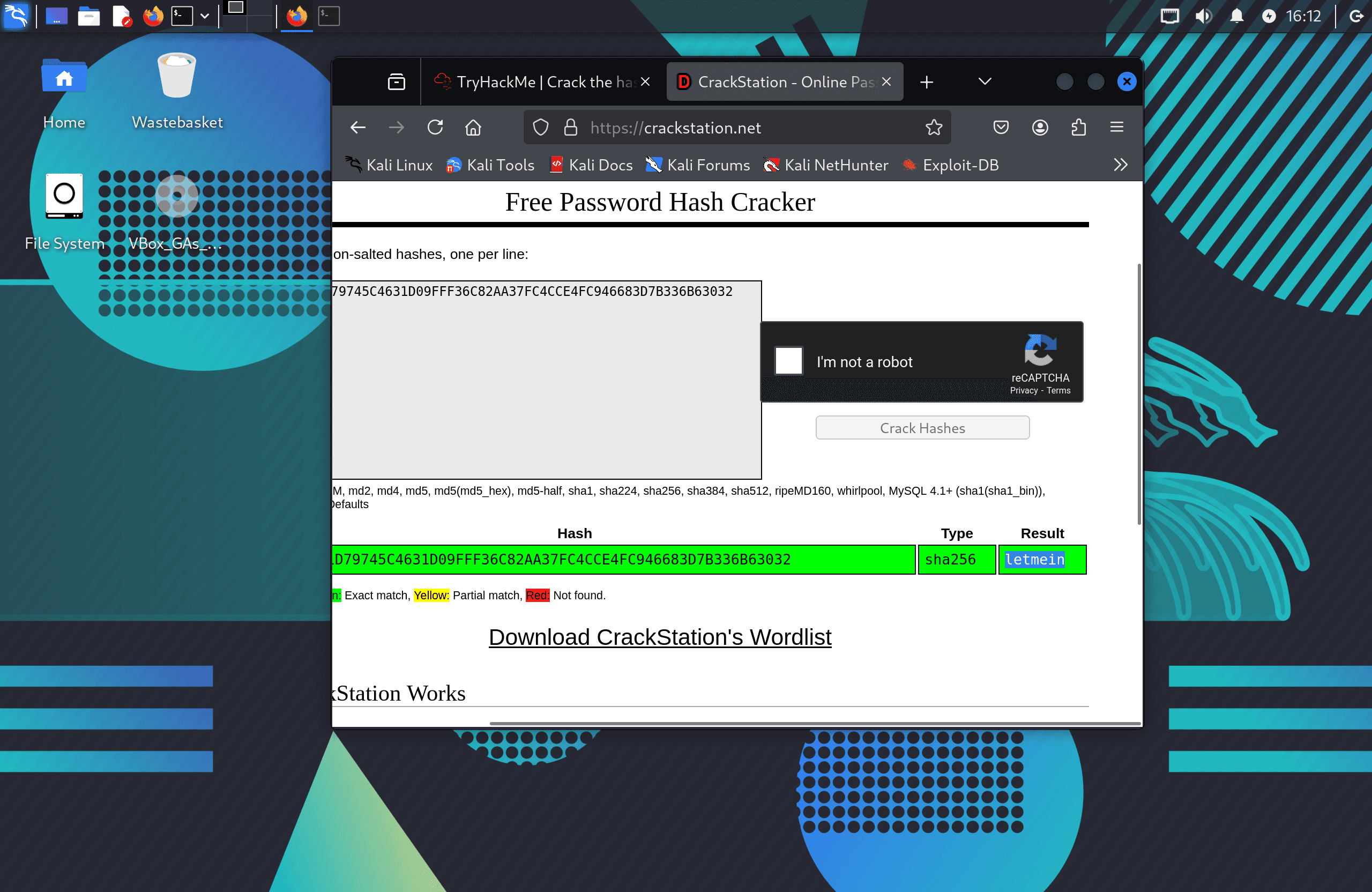
Hash 3: 1C8BFE8F801D79745C4631D09FFF36C82AA37FC4CCE4FC946683D7B336B63032
Identified as SHA-256. CrackStation returned no result, so I cracked it offline with Hashcat:
hashcat -m 1400 hash.txt /usr/share/wordlists/rockyou.txt
Password: letmein
Hash 4: $2y$12$Dwt1BZj6pcyc3Dy1FWZ5ieeUznr71EeNkJkUlypTsgbX1H68wsRom
The $2y$ prefix identifies this as bcrypt. The room hinted at a 4-character lowercase word, so I used a Hashcat mask attack rather than a full wordlist:
hashcat -m 3200 -a 3 hash.txt bl?l?l
Password: bleh
Hash 5: 279412f945939ba78ce0758d3fd83daa
Identified as MD4. Cracked using CrackStation.
Password: Eternity22
Section 2
The room confirmed all passwords in this section were in rockyou.txt. Hashes were more complex — salted and slower algorithms requiring specific Hashcat mode numbers.
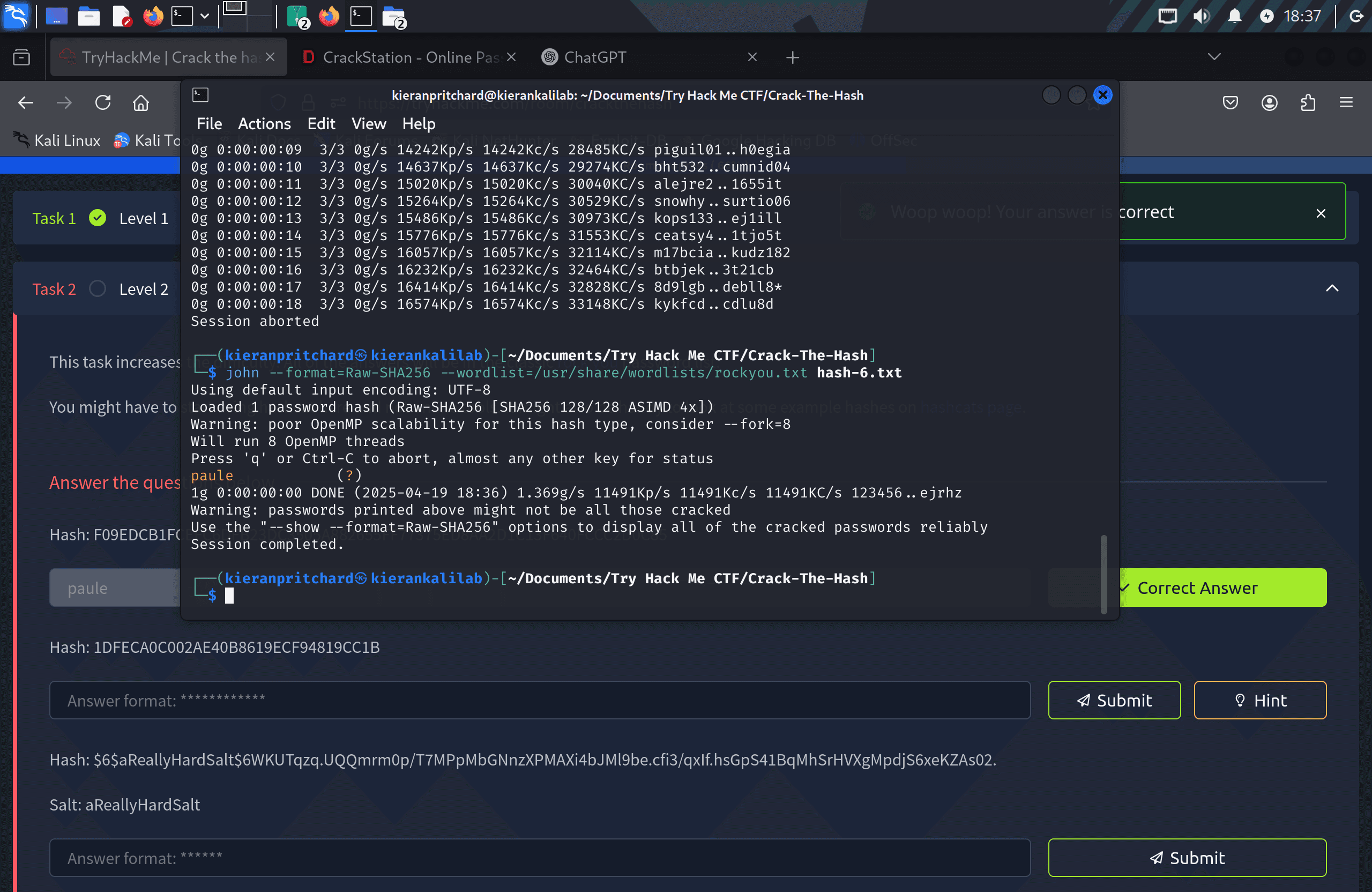
Hash 1: F09EDCB1FCEFC6DFB23DC3505A882655FF77375ED8AA2D1C13F640FCCC2D0C85
Identified as SHA-256. Cracked with Hashcat:
hashcat -m 1400 hash.txt /usr/share/wordlists/rockyou.txt
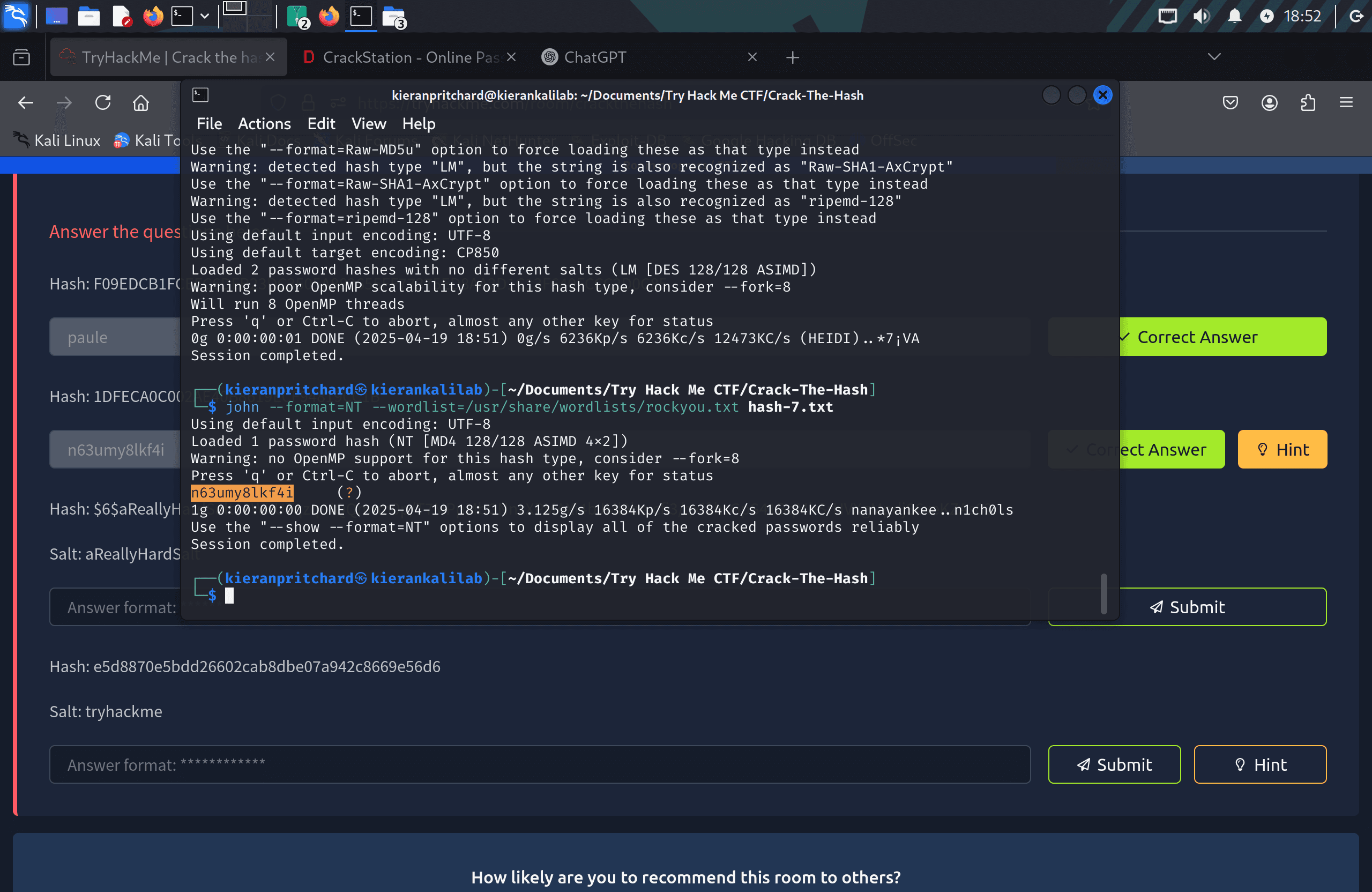
Hash 2: 1DFECA0C002AE40B8619ECF94819CC1B
hashid suggested MD5, but that mode returned no result. Checking the hint confirmed this was NTLM (distinct from the older LM format). Cracked with Hashcat:
hashcat -m 1000 hash.txt /usr/share/wordlists/rockyou.txt
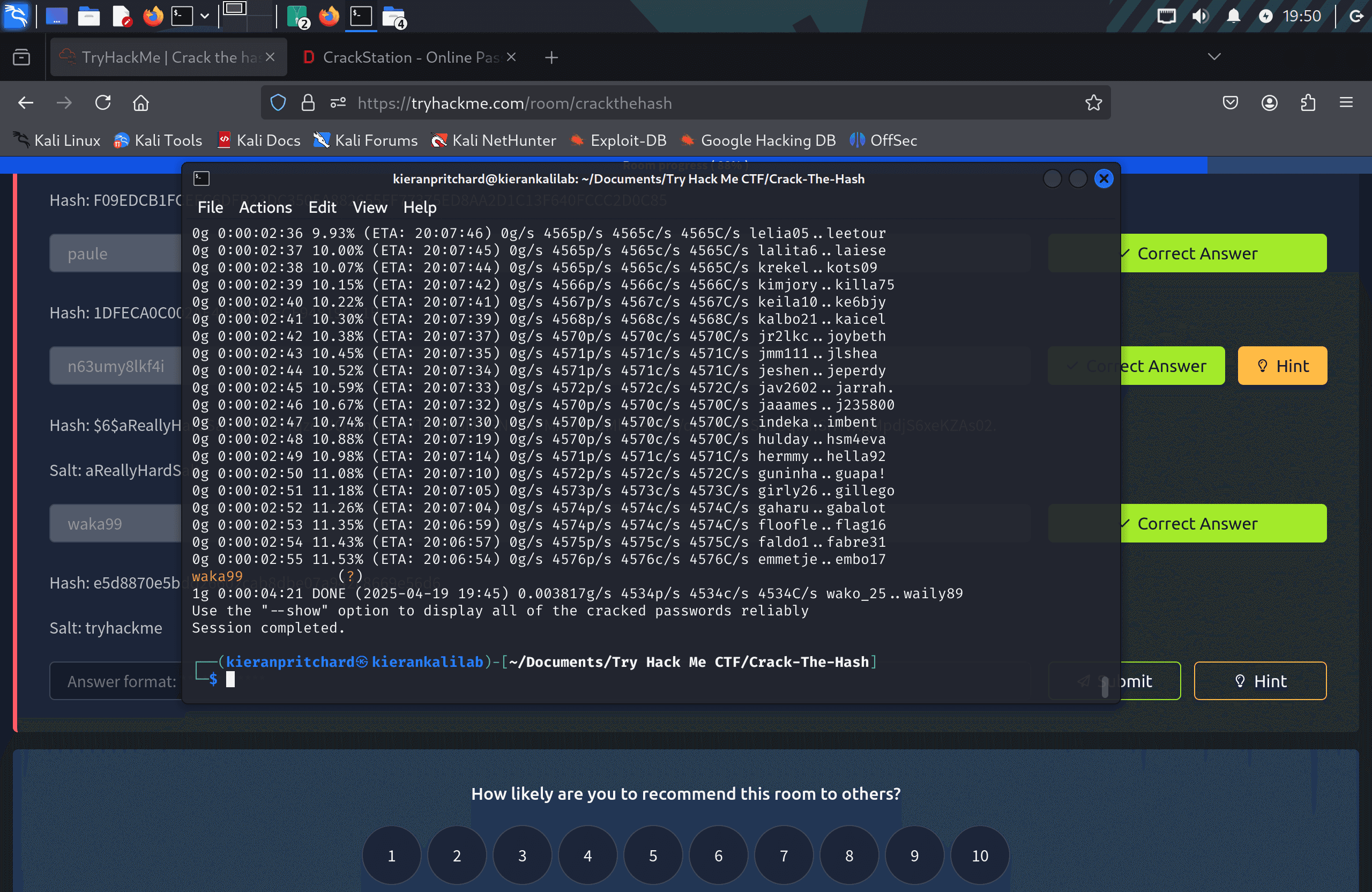
Hash 3: $6$aReallyHardSalt$6WKUTqzq.UQQmrm0p/T7MPpMbGNnzXPMAXi4bJMl9be.cfi3/qxIf.hsGpS41BqMhSrHVXgMpdjS6xeKZAs02.
The $6$ prefix identifies this as sha512crypt — the format used to store passwords in Linux's /etc/shadow. The salt (aReallyHardSalt) is embedded in the hash string itself, so Hashcat extracts it automatically. Cracked with Hashcat mode 1800 (note: this took significantly longer than the other hashes due to sha512crypt's intentionally slow key derivation):
hashcat -m 1800 hash.txt /usr/share/wordlists/rockyou.txt
Hash 4: e5d8870e5bdd26602cab8dbe07a942c8669e56d6
This appeared to be SHA-1 by length, but modes 110 and 150 (SHA-1 with salt) both failed. The room hint confirmed this was HMAC-SHA1 — a keyed hash where the salt acts as a secret key rather than simply being appended. The salt provided was tryhackme. The hash and salt must be passed together to Hashcat:
hashcat -m 160 hash.txt:tryhackme /usr/share/wordlists/rockyou.txt
Tools Used
- hashid — Hash type identification
- Hashcat — Dictionary attacks (
-a 0) and mask attacks (-a 3) with specific mode flags - John the Ripper — Wordlist attacks with
rockyou.txt - CrackStation — Online lookup for simple, unsalted hashes
Notes / Lessons Learned
- Hash identification tools like
hashidare a useful starting point but aren't always correct — checking hints and the Hashcat example hashes page is often necessary. - The
$2y$prefix indicates bcrypt,$6$indicates sha512crypt — recognising these prefixes saves time over running an identifier. - NTLM and LM are different hash formats with different Hashcat modes. Confusing them wastes cracking time.
- HMAC-SHA1 (
-m 160) requires the salt to be appended to the hash with a colon separator. Standard SHA-1-with-salt modes (-m 110,-m 150) will not work for this format. - Slow hashing algorithms like bcrypt and sha512crypt are intentionally computationally expensive — cracking them takes orders of magnitude longer than MD5 or SHA-1, which is the point.
- CrackStation is fast for common unsalted hashes but useless for salted or slow algorithms — knowing when to switch to offline tools is important.
Screenshots
1 / 7
2 / 7
3 / 7
4 / 7
5 / 7
6 / 7
7 / 7